Eosinophilic Esophagitis and the Body as Ecology
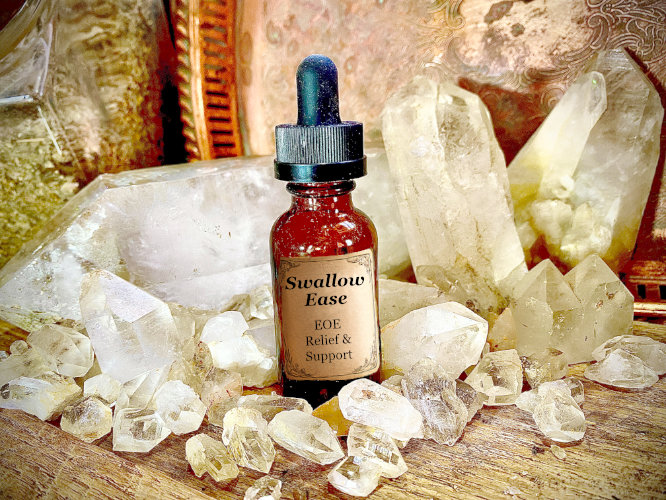
Eosinophilic esophagitis (e-o-sin-o-FILL-ik uh-sof-uh-JIE-tis) is a chronic immune system disease. With this disease, a type of white blood cell, called an eosinophil, builds up in the lining of the tube that connects your mouth to your stomach. This tube is also called the esophagus. This buildup, which is a reaction to foods, allergens or acid reflux, can inflame or injure the esophageal tissue. Damaged esophageal tissue can lead to difficulty swallowing or cause food to get stuck when you swallow. Esophagitis is swelling and irritation, called inflammation, of the tissues that line the esophagus. The esophagus does not swell in isolation. It swells because of a chain of communication, from the gut lining to the immune system to the nervous system, which shift the entire ecology of the body. These plants were wild harvested and gathered into this formula to help meet the chain reaction, in a way that can bridge the terrain once again.
Eosinophilic esophagitis is usually explained as just your esophagus having issues. It is mainly described as the esophagus swelling, food getting stuck, and then the diagnosis is given with a diet plan and a steroid spray. That description is accurate as far as describing what is happening. But it is also incomplete. It treats the esophagus as an isolated part of the body, rather than a piece of a much larger, communicating whole.
The esophagus is lined with a barrier: a wall of tightly joined cells that normally keeps food particles and environmental proteins on one side and the bloodstream on the other. In EoE, that wall loosens. Proteins that were never meant to cross it get through, and the immune system reads them as a threat. It answers this threat by sending eosinophils, a type of white blood cell built for fighting parasites (this may ultimately be the missing key), into the esophageal tissue. Eosinophils are not gentle. They release compounds meant to break down foreign material, and in EoE they release them into the body’s own esophageal wall, thickening the tissue, stiffening it, and making the simple, automatic act of swallowing into something now of a chore.
The eosinophils don’t act alone, though. Mast cells, the body’s histamine reservoirs, activate alongside them, keeping the tissue in a state of ongoing alert. Once the mechanism is understood this way, as a barrier problem, a signaling problem AND a tissue problem happening all at once, a formula built around one cause and one action stops making sense. This formula is built around three issues instead: the tissue itself, the immune signal driving it, and the nutritive ground the whole body stands on while it does this work.
Usage
Formula Guide
The Formula
I chose these specific plants to address the root causes of the espophagus, rather than just trying to ease the symptoms. Each of these systems: the digestive, immune, and histamine response, appears to be acting against the body. Yet, when we allow for us to see the body as an ecology, we can look into the root, and see that none of these systems work alone. That is the point of understanding the body as an ecology.
- Slippery Elm
- Swamp Mallow
- Plantain
- Self-Heal
- Goldenrod
- Pineapple Weed
- Nettle
- Mimosa
- Lemon Balm
- Beefsteak Plant
- Fennel
- Ginger
- Kale
- Raspberry
- Blackberry
- Pomegranate
- Muscadine Grape
- Matcha
Terrain One: The Tissue Itself
Plants that meet the esophageal lining directly, coating, soothing, and supporting its own capacity to repair.
The inner bark of slippery elm has been used for generations specifically because of what it does the instant it meets water: it releases mucilage, a complex chain of polysaccharides that thickens into a slick, gel-like substance. Taken as a stirred powder, that mucilage travels the same path food does, down the throat and across the esophageal lining, and it stays there, coating tissue that inflammation has made raw and reactive. This is a mechanical action rather than a chemical one. It doesn’t quiet the immune signal driving eosinophilic esophagitis, but it changes what that inflamed tissue has to withstand while the rest of the body’s healing catches up. Traditional use paired slippery elm with the body’s own repair timeline, taken consistently, after meals and before rest, so the coating has a chance to reform as often as it wears away.
Swamp mallow, more widely known as marshmallow root, works through the same mucilage mechanism as slippery elm, drawn out most completely through a slow, cold-water infusion rather than a hot tea, since heat tends to break down the very polysaccharide chains responsible for the coating effect. What sets swamp mallow apart in this formula is that it doesn’t stop at mucilage. Its root and leaf also carry a real quercetin content, along with kaempferol and isoquercitrin, placing this single plant at the seam between two terrains at once: it soothes the tissue directly while contributing to the same flavonoid signal that speaks to histamine and mast cell activity elsewhere in the formula. This dual action is part of why swamp mallow anchors the tissue terrain rather than only supporting it from the side. In traditional use, marshmallow root was prepared fresh and taken generously, cup by cup, because its gentleness meant there was little reason to hold back.
Plantain grows in the compacted soil of driveways and worn footpaths, places most plants can’t establish themselves, and its medicine reflects the resilience of where it grows. Its leaves carry both mucilage and a long-standing ethnobotanical reputation as a vulnerary, a plant used specifically on damaged tissue: bee stings, splinters, small wounds, irritated skin. That same drawing, soothing action translates to mucosal tissue internally. Plantain’s mucilage content means it contributes to the same physical coating mechanism as slippery elm and swamp mallow, but its traditional use record leans more specifically toward tissue that has been actively injured or irritated, rather than tissue that only needs general soothing, a meaningful distinction in a formula built for a condition defined by ongoing tissue damage from eosinophil activity. Plantain also carries mild astringent properties, gently toning tissue as it soothes it, a combination traditional herbalists have long paired for wounds that need to close as much as they need to calm.
Self-heal earned its common name honestly, carried across centuries of use for exactly the kind of tissue distress this formula addresses. Historical preparations were specifically used for inflammation and irritation of the mouth and throat, a direct ethnobotanical line to esophageal tissue, long before anyone understood eosinophils or mast cells. Modern research has since confirmed broad anti-inflammatory and antioxidant activity across the plant’s constituents, and more recent work has turned specifically toward self-heal’s role in supporting the intestinal barrier, the very structure whose breakdown sits at the root of eosinophilic esophagitis. When that barrier loosens, proteins the immune system was never meant to encounter slip through and provoke a defensive response. A plant traditionally used to calm irritated membranes, now being studied for its relationship to barrier integrity specifically, is a rare kind of continuity between old use and new research.
Goldenrod carries an undeserved reputation, blamed for allergy season symptoms that actually belong to ragweed, a much less visible plant that blooms at the same time but spreads its pollen on the wind, unlike goldenrod’s heavier, insect-carried pollen. Once that mistaken identity is cleared, goldenrod’s actual ethnobotanical record comes into view: Native American use included chewing the plant’s leaves and flowers specifically for sore throat, a direct application to irritated mucosal tissue. That traditional, throat-specific use is why goldenrod holds a place in this formula’s tissue terrain rather than only in its broader reputation as anti-inflammatory and immune-supportive. Harvested at flower and prepared as tea or tincture, goldenrod brings a gentle astringency alongside its soothing action, echoing the same tone-and-calm pairing found in plantain.
Pineapple weed grows in the same disturbed, sun-baked soil as many roadside weeds, easy to miss until its leaves are crushed and release a bright, unmistakable pineapple scent. It belongs to the same genus as German chamomile, and its ethnomedical record, going back over a century, reflects that family resemblance closely: used as tea or tincture specifically for anti-inflammatory and antispasmodic support. That antispasmodic quality matters directly in a condition where the esophagus itself can tighten and cramp around food that isn’t moving through easily. Where the coating herbs in this terrain change what the tissue has to withstand, pineapple weed works on the tissue’s tension itself, easing the muscular gripping that makes swallowing feel harder than it should.
Terrain Two: The Immune Signal
Plants that speak to mast cells, histamine, and the broader allergic-inflammatory cascade driving eosinophil activity.
Nettle’s sting is its own lesson in histamine biology. The fine hairs covering its leaves inject a cocktail of histamine, formic acid, and other irritants directly into skin on contact, yet the juice of this plant holds the very relief of its own sting. Nettle stands out among allergy-supportive herbs because its research base extends specifically into gastrointestinal allergic symptoms, not only the respiratory symptoms most people associate with allergy herbs. Documented use includes support against a broad range of allergic reactivity, a meaningfully different research profile than plants studied only for hay fever or hives. Nettle research has found it supports the GI tract directly. Nettle is also deeply nutritive, carrying iron, calcium, and a wide mineral profile that supports a body already working with a restricted diet, common in eosinophilic esophagitis management.
Mimosa carries the traditional name “tree of collective happiness,” used historically to calm an unsettled spirit as much as an unsettled body, and that dual reputation turns out to have a real mechanism behind it. Its bark and flower have a documented traditional and research reputation for stabilizing mast cell degranulation, the specific cellular event at the center of the allergic cascade driving eosinophilic esophagitis. When a mast cell degranulates, it releases histamine and a wave of inflammatory mediators into surrounding tissue; a plant that stabilizes that membrane, keeping the cell from releasing its contents so readily, works upstream of the inflammation itself rather than mopping up after it. Traditional use also describes mimosa as calming to an overactive immune response more broadly, a claim that aligns with its mast-cell-specific action.
Lemon balm’s reputation rests mostly in the nervous system, and that reputation is more directly relevant to eosinophilic esophagitis than it first appears. Swallowing is not a passive act; it’s a coordinated neuromuscular sequence, and a nervous system held in a chronic state of tension changes how that sequence unfolds, often making an already-difficult swallow feel more effortful and more anxious. Lemon balm’s calming action supports the whole act of eating, not only the tissue food passes through. Its profile is gentle and mucous-membrane-friendly, meaning it sits easily alongside the coating herbs elsewhere in this formula without working against their action, unlike some nervines that can be drying to mucosal tissue. Traditional preparations of lemon balm were often taken as a simple tea after meals, a habit that pairs naturally with a formula meant to be taken consistently around eating itself, when the nervous system’s relationship to food matters most.
Beefsteak plant, more commonly known by its Japanese name shiso, carries a deep-colored, distinctively flavored leaf that has long been part of both food and medicine traditions. Its most researched constituent for this formula’s purposes is luteolin, a flavonoid isolated directly from perilla leaves and studied specifically for its action on human mast cells. That research found luteolin reduced the release of inflammatory cytokines from mast cells and, notably, reduced histamine release itself when those cells were provoked, giving beefsteak plant one of the more direct, mechanism-specific placements in this entire formula. This isn’t a general anti-inflammatory reputation; it’s a documented action on the exact cell type at the center of the allergic cascade.
Fennel’s long-standing reputation is carminative, meaning it eases spasm and gas through the digestive tract, a quieter, more foundational action than the more targeted immune herbs around it in this formula. In a body already working harder than it should to move food through an inflamed esophagus, unnecessary tension elsewhere in digestion adds real burden on top of that primary struggle. Fennel takes some of that burden off, supporting smoother motility through the rest of the digestive tract so the whole system isn’t compounding its own difficulty. Traditional use of fennel seed, chewed after meals or taken as tea, reflects a practice built around eating itself, much like lemon balm, making both plants natural companions in a formula meant to be woven into daily meals rather than taken separately from them. Fennel’s mild, familiar flavor also makes it one of the easier plants in this formula for a person already managing significant dietary restriction to tolerate consistently.
Ginger’s reputation is old and wide, reaching across nearly every traditional medicine system that has encountered the root. Its warming, circulatory action supports blood flow to tissue that has been under chronic inflammatory strain, bringing nutrients and immune resources to areas that need ongoing repair. Ginger’s anti-inflammatory compounds, principally gingerols and shogaols, work through pathways that overlap meaningfully with the broader inflammatory cascade driving eosinophilic esophagitis, though ginger’s action here is general rather than eosinophil-specific. What makes ginger valuable in this formula isn’t a single dramatic mechanism; it’s how reliably it pairs with nearly everything else in this formula. Traditionally, gender is used alongside other herbs as a catalyst that helps the body take them up more effectively. Ginger also settles nausea and general digestive unease, symptoms that frequently accompany eosinophilic esophagitis alongside the primary swallowing difficulty.
Terrain Three: The Nutritive Ground
Whole foods carrying the polyphenols, flavonoids, and antioxidant compounds that feed long-term resilience rather than acute relief.
Kale earns its place in this formula on the strength of a single, well-documented number: comparative testing has found it carries a higher quercetin content than most berries, standing alongside onion and broccoli as one of the richest common food sources of this specific flavonoid. Quercetin itself has been studied directly for its action on mast cells, and in some research it outperformed cromolyn, the pharmaceutical mast cell stabilizer, at inhibiting the release of histamine and inflammatory cytokines from human mast cells. That research also found quercetin works prophylactically, meaning it appears to support the body’s baseline reactivity rather than only intervening at the moment of a trigger, which fits the long-term, daily nature of dietary support far better than an acute-response herb would. Including kale in this formula’s nutritive terrain is a way of building that specific flavonoid into daily nourishment rather than isolating it into a supplement, letting food do quiet, ongoing work alongside the more concentrated plant medicine elsewhere in the formula.
Raspberry and blackberry carry deep color for a reason; the pigments responsible for that color are part of a wider polyphenol profile that includes myricetin, a flavonoid closely related to quercetin but studied through its own distinct research base, alongside ellagitannins, a separate class of compounds altogether. Testing has found both berries are rich in myricetin. Myricetin shares its antioxidant and anti-inflammatory properties. While ellagitannin, which is also found in pomegranates and muscadine in this formula, these get broken down in the gut to become ellagic acid and urolithins, further helping to support cell health by lowering inflammation, fighting cell damage, supporting gut microflaura, and in addition, research shows it may help brain and heart function.
Pomegranate’s reputation as a health-supportive fruit is built almost entirely on one class of compound: ellagitannins, particularly punicalagins, concentrated heavily in its rind and the membranes surrounding its seeds. These compounds are not well absorbed in their original form; the body’s own gut microbiota metabolizes them into urolithins, a family of metabolites absorbed far more readily and carrying documented anti-inflammatory and antioxidant activity of their own. Muscadine grape carries this same ellagitannin chemistry in its thick skin and seed, distinguishing it from the thinner-skinned grape varieties most people know from the grocery store. Together these two fruits round out the formula’s nutritive terrain with a polyphenol pathway distinct from the quercetin and myricetin already present, which matters because a body benefits more from a varied polyphenol terrain than from concentrating everything into a single compound family, furthering us away from the popular concept of monoculture, back into the diversity of the wild.
Matcha is whole tea leaf that is stone-ground rather than steeped and discarded, which is why a serving of matcha delivers a meaningfully heavier catechin load than the same tea prepared as a standard infusion. Its most studied catechin, EGCG, carries a broad research record for immune-modulatory and anti-inflammatory activity, but the research more specific to this formula’s purpose comes from direct testing of tea-leaf catechins against histamine release from mast cells, where several catechin variants showed measurable inhibition.
How the Terrains Hold Together
Slippery elm, swamp mallow, plantain, self-heal, goldenrod, and pineapple weed meet the esophageal tissue directly, coating and calming what inflammation has made raw. Nettle, mimosa, lemon balm, beefsteak plant, fennel, and ginger speak to the immune and nervous system signal that keeps calling eosinophils and histamine into that tissue in the first place. Kale, raspberry, blackberry, pomegranate, muscadine grape, and matcha feed the nutritive ground underneath both of those layers, the long, slow terrain that determines how much resilience a body has to draw on over months and years of managing a chronic condition.
This is not a formula that treats the esophagus as an isolated problem to solve. It treats the whole body as the ecology it actually is, and gives each layer of that ecology something specific to work with.