The whole world watched a clock tick all day, only for the deadline to be postponed two more weeks.
Notice what just happened in your body when you read that. The exhale that isn’t quite an exhale. The relief that doesn’t feel like relief. That is not accidental.
This is what abusers do. This is what cults do. This is what empire has always done to the people living inside it. Hold the body at the threshold of threat long enough and it stops being able to discern. Stops being able to organize. Stops trusting its own perception. Another deadline. Another postponement. Maybe it’s all theater. Maybe you were overreacting. That doubt is the point. A nervous system held in chronic threat state is a nervous system that cannot revolt.
And it doesn’t matter who you voted for anymore. Because nothing has been done to stop what Trump is doing. We are all guilty of this monstrosity. We are all responsible. We compared Trump to Hitler, and our own family and friends didn’t listen. They couldn’t be bothered or they listened to his lies. And now we all have to pay for what is being done.
People wonder why people cut family members out of their lives. Kamala shared that this exact thing was going to happen. Bashar said Trump would start world war 3. And now the whole world was anticipating 8pm eastern on April 7, to see what will happen. If a red button will be pushed.
Trump posted this morning that “a whole civilization will die tonight, never to be brought back again” if a deal isn’t reached by his 8 p.m. deadline to reopen the Strait of Hormuz. NPR He has been threatening to destroy bridges, power plants, and water treatment facilities. Even before that deadline, US forces struck Kharg Island, Iran’s key oil export hub, and dozens of military targets overnight. NBC News
Iran called on “all young people” to form human chains around power plants in case of strikes. MS NOW Those people standing in human chains are real civilians trying to shield their infrastructure with their bodies. That is not metaphor. That is what desperation looks like when a government has already been partially destroyed and the next wave could take the lights off for an entire country.
The war has already caused an estimated 7.5 million barrels per day of crude oil to be shut in across Saudi Arabia, Kuwait, the UAE, Qatar, and Bahrain. Dubai Humanitarian, the largest aid hub in the world, has seen the number of countries it can supply drop from 25 in January to just nine in March. CNN
I talk a lot about civilizations collapsing because I have seen this coming for the past 15 years. I purposely moved off grid 8 years ago. Quit everything because I knew it would take time. And I am seeing this happen. Right in front of my eyes.
This is what the Sacred Embodied Human Animal has always known. Not as prophecy for its own sake. As body knowledge. As the thing that lives below ideology and above argument. Empire is not the natural state of human life. Control through annihilation is not the natural state of human life. The body knows this. It has always known this. Every tradition that ever existed was layered on top of something far older, something that remembers what it means to be an animal on a planet, accountable to the living world, not to flags or deadlines or men with red buttons.
Every empire that has ever existed has ended. After every ending, people were still growing food. Still gathering. Still holding their children. Still watching the stars.
Grieve tonight. Feel the full weight of what this is.
Allow for the rage, the disappointment, the tears, the sadness, the knowing that nothing will ever be the same. This is time for processing. Breathe. Stay in your body. Allow these emotions to move through you, so they don’t become stuck.
As I continue to travel through the Celestial Sanctuaries from the Earth’s perspective, I had spent 4 years connecting and traveling through these sanctuaries with the moon, before I realized that the Earth goes through these as well. Not just the sun from a zodiacal perspective. I can feel distinctly the shift as each one happens.
Keep an eye on your energy as we come toward CELESTIAL SANCTUARY 16 · 192.858°–205.714° · Apr 5–Apr 18 Star- Spica
I am building a Celestial Sanctuary portal on my website, and have several of the sanctuaries now listed, if you feel like going to main page you can click on the sanctuary as well.
On the collapse of a system built on imaginary money, the debt that keeps us captive, and what the Sacred Embodied Human Animal has always known about real wealth.
Written by Stephanie Bacquet Mathews
I learned a word two days ago that I cannot stop thinking about. Insolvent. It means you do not have enough income to pay your bills. Not that you are struggling, not that you are cutting back, not that it is tight this month. It means the math is broken. The bills are higher than the money coming in, and you cannot close the gap.
America is officially insolvent.
Someone put the numbers into a context that finally landed for me. Imagine you earn $64,518 a year. Your bills are $85,671 a year. And you are $1.34 million in debt. You cannot pay your bills. You definitely cannot make a dent on the interest on that debt. That is where the United States sits right now, today. The national debt crossed $39 trillion this month, and the deficit grows by roughly $70,000 every single second. Not per minute. Per second.
Trump campaigned on eliminating the national debt. His business career offers a very clear model for how he approaches debt, and it is worth naming plainly: his companies filed for Chapter 11 bankruptcy six documented times between 1991 and 2009, covering the Trump Taj Mahal, Trump Castle, Trump Plaza, the Plaza Hotel in Manhattan, Trump Hotels and Casino Resorts, and Trump Entertainment Resorts. The pattern was consistent each time: leverage up, pull out, let the creditors absorb the losses, move on. Bondholders, small businesses, and workers absorbed the damage while Trump retained his name, his fees, and his next deal. He used the phrase himself: “We’ll throw it into a chapter. We’ll negotiate with the banks. We’ll make a fantastic deal.”
He is running the same play on a country.
While the average American is watching prices double at the grocery store, the people closest to the White House have been extracting wealth at a speed that should make your jaw drop.
Trump’s sons, Eric and Donald Jr., are investors in multiple drone companies that have received hundreds of millions of dollars in Pentagon contracts, during a war their father started. Donald Jr.’s venture capital firm, 1789 Capital, backed Vulcan Elements, a 30-person startup, which received a $620 million loan from the Department of Defense; the largest loan in the history of the Pentagon’s Office of Strategic Capital. That contract was awarded three months after 1789 invested in the company. Eric Trump invested in an Israeli drone maker called Xtend, which secured a multi-million-dollar Pentagon contract; those very drones were then used in combat in Iran, marking the first time the US military deployed one-way attack drones in combat. The sons were given investments. A war followed. The drones their companies sold were used in that war. The money flowed back.
A Project on Government Oversight analyst said it plainly: everyone making contract decisions knows exactly whose relatives are on the cap table. An ethics watchdog said the deals presented, at minimum, “the appearance of impropriety.” Impropriety means the appearance of dishonesty, corruption and misconduct.
Meanwhile, Trump’s crypto venture, World Liberty Financial, netted the family approximately $500 million after a deal with a company called Alt5 Sigma. The Trump family holds 75% of the proceeds from the token sales through a family LLC.
This is not a left or right issue. Even large pro-Trump accounts on social media asked plainly: “Raise your hand if you voted for Trump so his kids could make money off government contracts.”
Here is the anatomy of Insolvency. This is what the numbers actually show. The United States spent $7 trillion in fiscal year 2025 and collected $5.2 trillion in revenue. The deficit was $1.8 trillion, one of the four largest in American history, and larger than any deficit outside of a war, a recession, or a national emergency. We are in none of those, officially. We are simply spending vastly more than we take in during a period that should be, by economic metrics, a period of relative stability.
Interest payments on the national debt hit nearly $1 trillion in 2025 and are projected to break $1 trillion in 2026. Interest is now the fastest-growing expense in the federal budget. Nearly one dollar in five of federal revenue will soon go to paying interest alone, before a single road is fixed, before a single school receives funding, before a single veteran is treated. The Congressional Budget Office projects deficits reaching $3.1 trillion annually by 2036.
Ray Dalio, one of the most successful hedge fund managers in history, called this a “debt death spiral” and warned about the depreciation of the dollar specifically. The Treasury Department’s own annual financial report describes the US net position as negative $41.72 trillion. A Fortune commentary from a former Comptroller General used a word I had never heard applied to a nation before: insolvent.
“Convenience will always create unnatural circumstances that will keep us captive to imaginary needs.” Stephanie Bacquet Mathews. I believe this is how we got here.
Debt as enslavement. Most Americans do not own their homes. They hold mortgages. Most Americans do not own their cars. They hold loans. Consumer debt in the United States has climbed past $17 trillion when you include mortgages; household and personal debt together represent a system that requires every participating body to keep working, keep producing, keep consuming, just to stay in place.
The credit score is perhaps the most elegant piece of this architecture. Your creditworthiness, your supposed measure of financial health, is built on debt. If you pay with cash, save rather than borrow, and carry no debt, you have a poor credit score. The system literally punishes you for not being indebted. It treats solvency as a liability. The only way to be considered financially trustworthy is to prove that you are good at managing debt, which means proving you are good at remaining in the system that keeps you working.
This is not accidental design.
Debt is the leash. It is elegant because it is invisible. A person with a car payment, a mortgage, a credit card minimum, and a student loan does not feel enslaved; they feel like a participant, a responsible adult, someone who has earned access to convenience. But the practical reality is that they cannot stop working. They cannot say no to a bad employer. They cannot take a season to grow food, to care for someone they love, to simply stop. The debt requires their continuous labor.
And now the system that created that debt for individuals is replicating it at the national level, while simultaneously making clear that it no longer needs the labor of those individuals the way it once did.
This is the question that keeps me up: If AI and automation replace most human labor within a decade, as the projections suggest, and the billionaire class no longer needs human workers to generate wealth, and the fiat money system is collapsing under debt that cannot be serviced, what exactly is the plan for the rest of us?
I think this is the right question. And I think the honest answer is that there is no plan for the rest of us.
Stocks, when denominated in dollars that are losing value, become abstract. Billionaire wealth, when stored in a currency that is collapsing, becomes abstract. The question “is their money still real if the dollar is no longer valuable?” is not a conspiracy theory. It is the correct economic question. And the answer is: not necessarily. Not in the way it is now.
What retains value when the fiat system buckles is not complicated. It is ancient. It is food. Water. Land. The skills to produce and preserve both. The relationships with neighbors that allow genuine exchange rather than market exchange. The knowledge of what grows here, in this soil, in this season. The capacity to birth, to heal, to build, to preserve without a supply chain.
People often think of toilet paper and bullets. You can survive a short crisis with those. You cannot survive what comes after an empire’s insolvency with them. What has always carried people through the collapse of economic systems is community, land knowledge, and the willingness to share labor.
The body has always known what has real value. The Sacred Embodied Human Animal does not need to be told by an economist that food matters more than fiat currency. It knows this. It knows it in hunger. It knows it in the satisfaction of eating something it grew. It knows it in the way a child reaches for real food before processed food if given both without marketing pressure.
The disconnection from this knowledge is not natural. It was engineered. It took generations of convenience, of packaging, of debt-financed access to things that simulate abundance without creating it, to get a population to the place where most people cannot grow food, cannot preserve a harvest, cannot identify a medicinal plant, cannot go three days without a supply chain. That is not human nature. That is the result of a system that needed people to be dependent in order to be profitable.
I am not 100% sustainable. I do not pretend to be, and I do not think that is the goal. I buy feed for my animals in winter. I rely on things I cannot produce alone. This is correct. We are not meant to be solitary, self-contained units of survival. We are meant to live in community, to specialize in what we love and do well, to offer that to the people around us and receive what they offer in return. That is what real economy means. Not extraction. Not debt. Not infinite growth. Reciprocity. Gift. Specialization in service of the whole.
Individualism is dying because it was never actually alive. It was a marketing strategy dressed as a value. The Sacred Embodied Human Animal is a communal creature. It does not thrive in isolation. It thrives in web, in relationship, in the kind of interdependence that a suburban cul-de-sac or a social media following cannot replicate, but that a real community of people who know each other’s land and skills and rhythms absolutely can.
The collapse is not the END! I want to say this directly, because I think fear is the primary response most people have to the word collapse, and fear is not useful.
The fiat money system collapsing is not the end of human life. It is the end of a particular arrangement of human life, one that has been running for about a century in its current form and that has been building toward this mathematical impossibility for decades. Empires borrow until they cannot. Currencies inflate until they cannot. Systems that require infinite growth on a finite planet eventually encounter the planet.
What comes after is not nothing. What comes after is always determined by what people were doing before the collapse; whether they were building dependence or building capacity, accumulating convenience or accumulating knowledge, storing money or storing seeds.
But I am growing food, breeding animals, continuing to learn which plants on this land hold medicine. My children know these things too. This is what humans did for 300,000 years before someone decided that depending on a supply chain and a credit score was the better arrangement.
The billionaires are making a category error. They think they can take the money and leave the earth. They think the data center is the future and the soil is the past. They think the body is a limitation to be transcended rather than the only intelligence that has ever actually sustained life on this planet. Transhumanism, is not something I enjoy looking more into. But it is what these tech billionaires believe. They don’t need humans, or clean air, or an Earth, if their bodies are not needed anymore.
But my body is needed. I love my body. I love my embodiment. I have stepped away from the death cult of Thanatos. (And yes, Jesus is a representative of Thanatos, and a death cult. But more on that another day.) I also have a matrifocal vision of sex and pleasure, rather than the cult of Eros’ perversion of sex and the need to power, master, control or contort others to get off. (Again more on that another day.)
The Sacred Embodied Human Animal knows better. It has always known better. And every time an empire has burned itself to the ground on its own debt and its own arrogance, the people who survived were the ones who still knew how to put their hands in the soil.
We are those people. We are building that knowledge now, while we still have time to build it with some stability around us. That is not small. That is not retreat. That is the most important work being done anywhere right now.
On empire’s oldest strategy, the war against embodied life, and why the Sacred Embodied Human Animal is the one thing they cannot extract, automate, or destroy.
They have done this before. This is the first thing you need to know. Not as a comfort, but as an orientation. When you feel the particular vertigo of watching a government hollow out its own airports while announcing victory in a war it started on a lie, while troops ship out and a general in Tehran says we have been waiting for exactly this for twenty years, that vertigo is pattern recognition. Your body knows this shape. It has been encoded in your nervous system across millennia of watching empire operate. The question is whether you will let that knowing metabolize into clarity, or whether it will stay stuck in your throat as fear.
Let us name the pattern.
The United States has a documented history of creating or exploiting crisis to justify expansion. The USS Maine exploded in Havana harbor in 1898 under murky circumstances, and within months the US had gone to war with Spain and seized Cuba, Puerto Rico, Guam, and the Philippines. The second attack in the Gulf of Tonkin in 1964, the one that sent 58,000 Americans and millions of Vietnamese to their deaths, was later confirmed by declassified NSA documents to have been fabricated entirely. Operation Northwoods, a declassified 1962 proposal, outlined a plan to bomb American cities and sink American ships, blaming Cuba, to justify invasion. The Kennedy administration rejected it. The plan existed.
This is not conspiracy. It is documented. It is history. The pattern is: manufacture or exploit a crisis, attach blame to a named enemy, acquire the public emotional permission to do what you already intended to do.
What is happening right now carries this shape in its bones.
TSA workers have gone unpaid for months. More than 450 have quit. The call-out rate has risen from 2% to 10%. ICE agents, trained for immigration enforcement, not threat detection, not explosives screening, not the granular work of identifying contraband, are being placed in airports to fill the visual role of security without performing its actual function. Iran’s military has stated publicly that they have been preparing for American boots on the ground for two decades, that their asymmetrical warfare strategy has been trained and waiting. Trump simultaneously claims the war is already won and sends another thousand troops from the 82nd Airborne. A peace agreement was reportedly within reach, Iran had agreed to halt uranium enrichment, full IAEA verification was on the table, and the strikes happened anyway. The US negotiator is accused by diplomats of misrepresenting the exchange.
This is the architecture of pretext. The airports are soft. The enemy is positioned and motivated. The justification for escalation is being built in advance.
The why beneath the why. I cannot stop sitting with: why? If you already have billions, why do you need a war? If you already have power, what is this actually for?
The honest answer lives at two levels, and you need both.
At the surface level, this is an extraction economy completing its transition. The old economy needed bodies: bodies in factories, bodies in fields, bodies as consumers who spent the wages of their labor. The new economy is structured around artificial intelligence and data infrastructure, and the Nobel laureate who helped build it has warned plainly that the major AI companies are betting on massive job replacement, because that is where the money is. A Senate report released in 2025 warned that AI and automation could eliminate nearly 100 million American jobs within a decade. Bill Gates stated publicly that within ten years, AI will replace most doctors, most teachers, that human expertise will become, in his word, free.
What do you do with a population of 330 million people when you no longer need their labor? When the data centers need land and water and energy but not the people who currently live on that land and drink that water? The rural dispossession happening through economic collapse, through disaster, through the slow evacuation of services from rural communities is not accidental. It is the clearing of the field.
War on American soil would serve this project with terrible efficiency. Emergency powers suspend civil liberties. Mass fear makes population management easier. The concentration of resource decisions in fewer hands gets justified as wartime necessity. And the populations most likely to organize, to resist, to remember older ways of living: rural, land-connected, and community-rooted people, are the first ones emergency powers and economic collapse reach.
But there is a second level. The deeper level. And this is where the Sacred Embodied Human Animal framework becomes not just relevant but essential.
The Death Cult has just moved to the DATA Centers. The people orchestrating this moment are not simply greedy. Greed is an embodied thing. It wants pleasure, accumulation, the sensory satisfaction of having. What we are watching is something older and stranger. It is the philosophical tradition of body-hatred wearing the mask of progress.
Elon Musk has said explicitly that he considers human beings too slow, too irrational, too biological. The transhumanist vision shared across a small constellation of extraordinarily powerful men is a future in which consciousness uploads, in which the meat of the body becomes optional, in which the slow somatic wisdom of animal life is replaced with the frictionless speed of pure computation. They genuinely believe this is an upgrade. They believe the body is a limitation. They believe that what is most valuable about human beings is separable from the fact of being embodied, from having feet on soil, from the 38 trillion microorganisms that constitute the ecology of a single human gut.
This is a spiritual crisis masquerading as a technological vision. And it is the oldest spiritual crisis in the Western tradition, the Gnostic suspicion that matter is corrupt, that the body is a prison, that transcendence means escape from the physical. It has been running through Western civilization for two thousand years. We are watching its billionaire endpoint.
They cannot feel their feet on the ground. The research on embodied cognition, on nervous system regulation, on the somatic intelligence that lives below the threshold of language. This is the intelligence that tells you something is wrong before you can name it, that registers the weight of a child in your arms as information, that knows which plants are safe by smell, by texture, by the particular intuition that comes from years of walking the same land. This intelligence has no API. It cannot be extracted, compressed, uploaded, or replicated. It lives in the body and it dies when the body is severed from the earth.
They are terrified of what they cannot have. And they are building a monument to that terror and calling it the future.
Here is what the historical record shows about empires that wage war on the bodies of their own populations: they always underestimate what lives in those bodies.
Rome reached its maximum territorial extent and began its long collapse from within, not because the barbarians were stronger, but because the center could not hold. The extractive logic that stripped the provinces bare eventually stripped the center too. The knowledge that lived in the provinces, how to farm that particular soil, which plants held which medicinal properties, the water systems, the seasonal rhythms. That knowledge did not upload to Rome when the empire took the land. It stayed with the people. And when the people dispersed or died, the knowledge went with them. What came after was called the Dark Ages by the people who lost the empire. The people who survived in the margins, who had been practicing embodied land-based life all along, simply continued.
This is the pattern the billionaires cannot see because they have never looked at history from the bottom. They are looking at it from the top, from the vantage of who held power, who built monuments, who left records. They are not looking at what persisted. What persisted was not written in imperial Latin. It was written in seed varieties, in the memory of where the medicine plants grow, in the knowledge of how to birth a baby without a hospital, in the ability to read weather in the body of the land.
That knowledge is what I carry. That knowledge is what my children are learning. That knowledge is not stored in a data center anywhere.
I watch people’s nervous systems blow out in real time watching the news. They scroll. The next thing. The next horror. The cortisol spike that never fully resolves before the next one arrives. And I understand the impulse: if I just keep watching, if I just keep tracking, I will somehow stay ahead of it. I will know enough to be safe.
But the nervous system does not work that way. A body kept in chronic threat activation loses its capacity for the kind of thinking this moment actually requires. The prefrontal cortex, the seat of long-range planning, of seeing pattern, of imagining futures that do not yet exist, goes offline when the amygdala is running the show. You cannot plan the world you want to inhabit from inside a panic response.
This is not a spiritual bypass. I am not telling you to breathe and think positive thoughts while the airports go unguarded. I am telling you that the regulation of your nervous system is a political act. A body that can feel its feet on the ground, that can eat food it grew, that can sit for twenty minutes in the presence of a plant it knows by name, that body can think. That body can act from its actual values rather than from fear. That body is harder to manage.
The enemy of the surveillance state is not a secret. It is presence. It is the capacity to remain in your own body while the noise machine runs at full volume. Every day I practice that, every morning I walk the land, every time I wildcraft a plant and feel its particular texture between my fingers, every meal I eat from my own soil, I are doing something that has no equivalent in their architecture. I am practicing a kind of intelligence they cannot replicate and cannot take.
I want to be clear-eyed with you about what is coming, because I think you deserve that more than you deserve false comfort. The conditions being assembled right now, the hollowed-out security apparatus, the active state of war with an adversary that has been preparing for two decades, the population kept in chronic fear and economic instability, these conditions are dangerous. Something could happen. And if something happens, the response will be used to justify everything that comes next.
I am not telling you this so you can be more afraid. I am telling you this so you can stop being surprised. Surprise is the most disorienting part of any crisis, the gap between what you thought reality was and what it turns out to be. Close that gap now. The people in power are doing what people in power do when they have convinced themselves that the population is a problem. This has happened before. It is happening now. You are not crazy for seeing it.
And the empire always ends.
Not because good defeats evil in some final cinematic reckoning. It ends because the extractive logic eats itself. Because you cannot run a civilization on the premise that human bodies are liabilities. Because the knowledge that lives in land-connected, community-rooted, seasonally-attuned human animals is the knowledge that actually sustains life, and when you drive that knowledge underground, you eventually lose the capacity to maintain what you built. Rome fell. The British Empire fell. Every extraction economy in human history has eventually consumed the substrate it depended on and then collapsed.
What comes after is always the question. And the answer to that question is being built right now, in places like mine. On the 22 acres. In the wildcrafted medicine. In the communities practicing the skills of actual interdependence rather than the simulation of it that consumer culture offers.
The Sacred Embodied Human Animal is not a concept. It is what has always survived. It is the seed bank. It is the oral tradition. It is the grandmother who knew which roots to eat when the stores ran out. It is in me, right now, choosing to stay in my body while everything screams at me to dissociate.
The empire cannot have this. They have tried. They will try harder. And they will fail, the way they always fail, because the intelligence that lives in a body that knows its land is older than every empire that has ever tried to erase it.
Stay rooted. Stay embodied. Stay in the conversation that matters.
February 22 – March 6, 2026154.287° – 167.143°The Star
Zosma sits at 154.287° and is the first star you encounter as Earth enters this slice of sky. The name derives from the Greek for hip or girdle, describing its physical position in the stellar body long associated with the lion constellation. But stripped of that mythological frame, what Zosma actually is: a white A-type main sequence star, about 2.2 times the mass of our Sun, burning roughly 15 times brighter, sitting 58 light years away. It is young by stellar standards, perhaps 750 million years old, still in the bright prime of hydrogen fusion.
Zosma is also notable for what it is becoming. It sits in the mass range where stars end not as quiet white dwarfs but as supernovae, incurring a violent, explosive death that seeds the surrounding space with heavy elements. Zosma has not reached that threshold yet, but it is heading there. It carries within it the physics of eventual catastrophic release.
There is something in that, a star in its productive, generative phase, still burning bright, already carrying the seeds of what it will eventually become. Holding, in its very physics, the trajectory of its own transformation.
2026
Lived in This Slice
This is the sky Earth sits in from late February into early March. What Earth moves through here is a region of clarity.
I submitted my doctorate dissertation in this sanctuary. Years of accumulation, research, embodied knowing distilled into the form required by the institution and most people. There is something worth naming about the timing of entering a slice of sky governed by a star in its productive prime, doing the work of sustained fusion, and submitting the document that represents the most sustained intellectual work of my formal academic life. I will have to wait another 6–8 weeks for it to be reviewed and accepted, but that feels like a short amount of time, with the years of knowledge and experiences that went into creating the thesis.
In this same sanctuary I wrote the article examining women, narcissism, and Trump and the article tracing the Bible as the structural root of the Epstein network, rather than the supernatural devil figure that does not even appear in the text people claim to derive him from.
What surfaced in this writing was the clarity of seeing how religious indoctrination functions as a control system. The devil is not in the Bible the way people have been told. The original Hebrew texts contain a ha-satan, the adversary, the accuser, a role, not a being. The supernatural evil figure who runs a counter-kingdom, who inhabits people, who is responsible for the suffering the powerful cause, that figure was constructed. Built deliberately. Because if the devil did it, the institution did not. If evil is supernatural, power is not accountable.
This is what Epstein’s network reveals at its structural root: not supernatural evil, but organized institutional evil protected by the same patriarchal theology that teaches women to submit, teaches children to obey, teaches the abused to question their own perception. The Epstein files were released in Sanctuary 11. The clarity about what built the conditions for Epstein arrived here, in Sanctuary 13, in the white-blue light of a star burning steady and clear.
There is something about A-type stellar energy, it is clear, unfiltered, no obscuring gas or dust nearby, just the direct light. That feels resonant with this kind of seeing. Just here is what is actually there. Look at it directly.
The Farm Auction
On February 28, deep in this sanctuary, Travis and I went to a farm auction. We went back every day for a week. We needed materials: for the greenhouse, for the two-story cob house we are building that will hold not just our family but community, friends, the gathering of people who are choosing to live differently.
The auction itself was discouraging. We kept getting outbid on the things we came for. We found out later we had been outbid by someone scrapping the metal, not using it, not building with it, pulling it apart for cash weight. The thing we needed, going to be destroyed.
And then, the owners found us the next day while we were loading what we had won. They had heard we were building off-grid, actually using the materials, not scrapping them. They told us to take anything left behind. Whatever remained unclaimed was now ours.
Then the scrapper himself found out all we had wanted from his haul was the windows from the screen doors he was tearing apart. He gave us over a hundred windows. We gave him $10 for some wooden ones he didn’t want. Over a hundred windows, for $10, because we told him what we were building.
We bid and won: OSB plywood. Thin wood for finish work. Four cast iron bathtubs, for the hot spring dreams at the bottom of the property, the ones we have been imagining. Shelves. Hinges. Brackets. Beautiful glassware for the new house. Travis got a bus load, filled the skoolie literally to capacity, of vintage Christmas items to sell. We came home with more than we came for, through channels we could not have planned.
This is what I mean about the physics of this slice. Zosma is a star heading toward supernova, the destruction is already built into the productive phase. The scrapper was tearing apart what we needed. What looked like the path being closed turned out to be the material being freed up for us. The same energy, but something that appears to be ending or destroying redirects into something being given, found, and received.
We were outside every single day. The land was awakening. Greenery coming up everywhere, finally. The long grey of deep winter cracking open into the first green. My body knew it before I named it, that particular aliveness that comes from watching the land remember what it is.
Finishing, Before the New
This sanctuary was also the tying up of loose ends, the last threads before spring’s new beginning arrives. The dissertation submitted. The articles written. The auction completed. The materials home. A sense of accounts settled, of things that had been hanging now resolved.
This is the energy of finishing what you started so you can be ready for what comes next. Not winding down. Completing. There is a difference. Completion is its own kind of fullness.
If you’ve noticed your desire for intimacy declining and assumed it’s just hormones, age, or “the way things are now,” I want to show you something different. Your libido didn’t disappear because something is broken in you. It disappeared because your body is responding exactly as it should to what’s actually happening inside you: chronic stress, poor circulation to your pelvis, a nervous system stuck in survival mode, and stagnation in the very tissues that need to be alive and responsive for pleasure. When the Sacred Embodied Human Animal is in captivity and distanced from its natural way of being.
I am going to share with you what’s really happening in your body when desire fades, and how these wildcrafted plants address the root causes.
What Actually Creates Desire and Arousal
Women’s sexuality is not simple. It’s not a switch that flips on. It’s a complex interplay of nervous system state, blood flow, hormonal signals, emotional safety, and being present in your body instead of stuck in your head. When any of these systems are compromised, desire fades.
Before we go further, let’s acknowledge something important: women are the only humans whose sexuality exists completely independent of fertility. Men’s libido is tied to their capacity for reproduction throughout their lives. But women’s desire, women’s capacity for pleasure, continues and often intensifies after menopause when reproduction is no longer possible. This tells us something crucial: women’s libido is not about reproduction. It never was. It’s about pleasure, sensation, aliveness, connection to your own body.
This is why the conversation about women’s libido needs to move beyond hormones and reproduction. Your desire isn’t a biological trick to get you to reproduce. It’s an expression of vitality, of being alive in your body, of your capacity for pleasure as a fundamental aspect of being human.
Here’s what needs to be working for arousal and libido to be alive:
Your body demands adequate blood flow to genital tissues. Arousal requires blood. Your clitoris, labia, and vaginal walls need to engorge with blood for sensation, lubrication, and pleasure. This is no different from how male arousal works. If circulation to your pelvis is poor, if blood is stagnant, if vessels are constricted, arousal becomes difficult or impossible regardless of how you feel mentally or emotionally. This has nothing to do with fertility. This is about the physical capacity for sensation and pleasure.
Your body requires a calm nervous system. Your body cannot be in arousal and stress at the same time. When your sympathetic nervous system is activated (fight, flight, freeze), blood flow is directed away from your digestive organs and your pelvic region toward your muscles and brain. This is survival physiology. Your body is saying “this is not the time for pleasure or sensation, we need to survive.” For arousal to happen, you need to be in your parasympathetic nervous system, the rest and digest state where your body feels safe enough for pleasure.
Many women carry chronic tension in their pelvis from stress, trauma, sitting too much, or simply from living in a culture that teaches women to constrict and hold rather than relax and open. This tension creates stagnation. Blood flow and lymph flow slow down. Tissues become less responsive. Sensation decreases. Your pelvis needs to be alive, flowing, responsive.
Allowing for hormonal support without hormonal dominance. Yes, hormones matter. But libido isn’t just about estrogen or testosterone levels. It’s about the entire hormonal cascade working together: stress hormones being managed, insulin balanced, thyroid functioning, and sex hormones in proper ratios. And here’s what’s important: many women report their strongest, most embodied desire after menopause, when estrogen is lower but they’re finally free from the hormonal fluctuations of monthly cycles. This tells us that desire isn’t about high hormone levels. It’s about hormonal balance and the freedom to experience sexuality on your own terms.
Pleasure needs an embodied presence. You cannot be aroused when you’re dissociated from your body. If you’re in your head, analyzing, performing, worrying, judging, you’re not in your body feeling. Arousal requires being present in sensation, which requires a nervous system calm enough to allow presence.
This is why “just relax” doesn’t work. You can’t think your way into relaxation. You need to address the actual physiological states that prevent your body from accessing arousal.
Let’s talk about what stress actually does to your ability to feel desire.
When you’re stressed, chronically or acutely, your body releases cortisol and adrenaline. These hormones do several things that directly impact libido:
In stress response, blood moves away from your digestive system, your pelvic organs, and your skin, toward your large muscles and your brain. This is why your hands and feet get cold when you’re anxious. This is also why your pelvis gets less blood flow when you’re chronically stressed. Less blood flow means less capacity for arousal, less sensation, less lubrication.
From your body’s perspective, stress means threat. When there’s a threat, pleasure of any kind is not a priority. Your body is in survival mode. The capacity for pleasure, sensation, desire, all of these require a nervous system state that says “we are safe enough to feel good.” Stress actively suppresses this capacity. This happens even when the “danger” is just your overloaded schedule, your financial worries, or your emotional exhaustion.
Chronically elevated cortisol interferes with the production and function of estrogen, progesterone, and testosterone. Your body prioritizes making cortisol over making sex hormones because survival takes precedence over everything else.
When you’re in sympathetic activation most of the time, your body forgets how to drop into parasympathetic. You lose the ability to feel safe, to relax, to be present. And arousal requires all of those.
This is why women with demanding jobs, young children, financial stress, or chronic anxiety often have no libido regardless of their hormone levels. It’s not a hormone problem. It’s a nervous system and stress problem.
The Pelvic Congestion Problem No One Talks About
Many women have stagnant, congested pelvises without knowing it. This isn’t a medical diagnosis. It’s a functional reality.
Your pelvis has extensive networks of blood vessels and lymphatic vessels. When these flow well, tissues are nourished, waste is removed, and everything is responsive and alive. When flow slows down or stops, tissues become congested. This looks like:
Chronic pelvic tension or discomfort. Heavy, dragging sensations in the pelvis. Decreased sensation during sex. Difficulty with arousal even when you want to be aroused. Longer times to orgasm or inability to orgasm. Vaginal dryness even with adequate estrogen.
Pelvic congestion happens from sitting too much, from chronic stress and tension, from holding patterns in your pelvic floor, from scar tissue, from inflammation, from previous infections or surgeries. It creates a pelvis that is physically not capable of the blood flow changes needed for arousal.
Moving this stagnation is essential for restoring sensation and desire.
The Plants That Restore Blood Flow and Circulation
These plants don’t just “increase libido” through some vague mechanism. They physically increase blood flow to genital tissues, which is required for arousal.
Ginseng is one of the most researched plants for sexual function in both men and women. It works by increasing nitric oxide production. Nitric oxide is the molecule that signals blood vessels to dilate. More nitric oxide means more blood flow. Research consistently shows that Ginseng improves arousal, lubrication, and satisfaction in women. But Ginseng also works as an adaptogen, helping your body manage stress, which means it’s addressing the nervous system component at the same time it’s improving circulation.
Puncture Vine (Tribulus terrestris) has been used traditionally across multiple cultures for sexual vitality. Modern research shows it increases blood flow to genital tissues and may increase sensitivity to touch. The saponins in Puncture Vine appear to support nitric oxide pathways similar to Ginseng, creating vasodilation in pelvic tissues.
Goji Berry (Wolfberry) improves circulation throughout the body, including to reproductive organs. It’s been used in Traditional Chinese Medicine for centuries to support sexual vitality and “essence.” Modern research shows it increases antioxidant capacity and may improve hormonal signaling related to sexual function.
Rosemary is a powerful vasodilator. It improves circulation to extremities and to the pelvic region. The volatile oils in Rosemary stimulate blood flow while also providing antioxidant protection to vascular tissue. Better circulation means better capacity for engorgement and sensation.
Horse Nettle, a member of the Solanaceae family, acts as a circulatory stimulant. It increases blood flow particularly to areas that are stagnant or congested.
Moving Pelvic Stagnation
This is where this formula does something most aphrodisiacs don’t address.
Ocotillo is extraordinary for pelvic congestion. This desert plant moves stagnation like nothing else I’ve encountered. It’s traditionally used for stuck blood and lymph in the pelvis and abdomen. When you have stagnant tissues that aren’t responsive, that don’t engorge easily, that feel dull or numb, Ocotillo starts moving that fluid. It’s like opening a drain on a backed-up system. As flow restores, sensation returns.
Bindweed, from the Morning Glory family, supports circulation and has traditional use for moving stagnant conditions. It helps break up the congestion that prevents responsive tissue.
These plants aren’t stimulating arousal artificially. They’re removing the physical blockages that prevent your body from responding naturally.
Calming the Nervous System: Creating Safety for Desire
You cannot will yourself to feel safe. Safety is a physiological state, not a mental decision. These plants help your nervous system shift from sympathetic activation to parasympathetic receptivity.
California Poppy is a nervine that reduces anxiety without sedation. This is crucial. You don’t want to be sleepy. You want to be calm and present. California Poppy helps quiet the mental chatter, the performance anxiety, the hypervigilance that keeps you in your head instead of your body. It allows for embodied presence.
May Pop (Passionflower) works similarly. It calms anxiety and helps you drop into your body. Passionflower has been used traditionally to help people be present with sensation rather than caught in thought loops or worry.
Pineapple Weed gently calms the nervous system and digestive tract. It helps release the chronic tension that many women hold in their solar plexus and belly, tension that prevents full relaxation into pleasure.
Blue Phlox and Bluets are both gentle nervines that support nervous system regulation without causing drowsiness. They help create the calm, receptive state that allows arousal.
Maidenhair Fern is traditionally used as a calming plant that helps with presence and embodiment. It’s gentle, not forcing, allowing your system to soften.
Hormonal Support Without Hormonal Intervention
This formula isn’t about flooding your system with hormones or hormone precursors. It’s about supporting the hormonal signals that create desire while managing the stress hormones that suppress it.
And let’s be clear about something: the narrative that women’s sexuality declines with age because of declining hormones is incomplete at best. Many women experience their most powerful, most embodied sexuality after menopause. Why? Because women’s desire was never primarily about reproduction. When the hormonal fluctuations of monthly cycles stop, when the possibility of pregnancy ends, many women finally access their sexuality on their own terms, for their own pleasure, without the underlying biological agenda that reproduction creates.
This is uniquely human and uniquely female. Women are the only humans whose libido exists completely independent of fertility. Your desire after menopause, your capacity for pleasure when reproduction is impossible, reveals the truth: your sexuality is about you, about being alive in your body, about pleasure as a fundamental aspect of vitality.
Wild Yam contains diosgenin, a compound that supports progesterone production and balance. While Wild Yam doesn’t directly convert to progesterone in the body (that’s a myth), it does support your body’s own progesterone production. Progesterone is often overlooked in discussions of libido, but adequate progesterone is necessary for balancing estrogen and creating the hormonal environment where desire can flourish, at any age.
Goat’s Rue has traditional use for hormonal support. It’s known primarily as a galactagogue (promoting milk production), but its effects on hormonal signaling appear broader. It supports the complex hormonal communications that regulate reproductive function.
Ginseng works adaptogenically on your stress hormone cascade. By helping your body manage cortisol more efficiently, it indirectly supports sex hormone production and function. When cortisol is managed, your body has more resources to make estrogen, progesterone, and testosterone.
Arousal requires being in your body, in the present moment, in sensation rather than thought. The aromatic plants in this formula help create that state.
Desert Sage is intensely aromatic and grounding. Its scent and energetic properties help you drop into your body and into present moment awareness. There’s a reason Sage has been used in ceremony and ritual for millennia. It shifts consciousness, helping you move from ordinary awareness to embodied presence.
Rosemary is both circulatory and aromatic. Its scent is clarifying and enlivening. It helps clear mental fog and brings you into your senses.
These plants aren’t just working biochemically. They’re working on your consciousness, your presence, your ability to be here now in your body.
This formula is different from a hormonal balance potion. Hormonal balance support is about regulating menstrual cycles, easing menopause symptoms, stabilizing mood swings, and creating overall hormonal equilibrium. That’s addressing the foundation of how your endocrine system functions throughout different life phases.
This formula is about arousal and desire specifically. It’s working on the immediate physiological requirements for sexual function: blood flow, nervous system state, pelvic responsiveness, and embodied presence. These are supported by hormones but not dependent on reproductive hormones.
This is why this formula works across all ages and life phases. Whether you’re 25 or 65, whether you’re cycling or post-menopausal, whether you can get pregnant or not, your capacity for desire and pleasure exists. It requires circulation, nervous system calm, pelvic aliveness, and presence. That’s what these plants address.
Think of it this way: hormonal balance creates the foundation for health throughout your cycles and transitions. This formula creates the conditions for pleasure and desire that exist independent of where you are in your reproductive life. They work beautifully together, but they’re addressing different aspects of your experience.
For immediate effects before intimacy: Take 7 to 12 drops under the tongue, hold for 20 seconds to allow absorption through the mucous membranes, then swallow. Take this 20 to 30 minutes before you anticipate wanting to be intimate. You’re giving the plants time to increase circulation, calm your nervous system, and create the physiological state for arousal.
For longer-term restoration of libido: Take 7 to 12 drops under the tongue, two times daily, for five days, then take two days off. This cycling allows your body to restore its own capacity for desire. You’re not creating dependence on the plants. You’re supporting your body as it remembers how to access arousal naturally.
Many women notice immediate effects with acute dosing, particularly increased sensation and easier arousal. Long-term use tends to create more sustained improvements: more spontaneous desire, more responsiveness, more pleasure, more ease in becoming aroused.
Women’s sexuality has been suppressed, shamed, controlled, and misunderstood for centuries. We’ve been taught that desire is something that happens to us, not something we own. We’ve been taught to perform pleasure rather than experience it. We’ve been taught that our sexuality exists for someone else’s benefit.
This conditioning lives in your body. It shows up as tension, as dissociation, as the inability to relax into pleasure, as the constant mental chatter during intimacy. Healing libido isn’t just about blood flow and hormones. It’s also about reclaiming your body as your own, recognizing your pleasure as legitimate, and learning to be present in sensation without judgment or performance.
These plants can’t undo cultural conditioning. But they can create the physiological conditions where you’re capable of presence, sensation, and pleasure. They can give you the embodied experience of what arousal feels like when your nervous system is calm, your circulation is flowing, and your body is responsive. That experience itself can be healing.
Sacred Embodied Human Animals
We are, at our most essential, animals. Not broken animals waiting to be fixed by the right supplement or the right mindset shift or the right cultural permission. Whole animals, with bodies designed by millions of years of evolution to feel, to sense, to desire, to experience pleasure as a natural expression of being alive. The Sacred Embodied Human Animal knows that her sexuality isn’t a problem to be managed or a function to be optimized. It’s an aspect of her aliveness, as natural as hunger, as legitimate as thirst, as fundamental as breath. Somewhere in the long project of civilization, we were taught to live above our bodies, to distrust our animal nature, to treat pleasure as indulgence and desire as weakness. That teaching is the wound. Your body never forgot what it was made for. It never stopped being an animal body, responsive to the world, wired for sensation, capable of deep pleasure when the conditions of safety and flow are present. Reclaiming your desire is not about adding something that was missing. It’s about returning to what you already are.
Your body is designed for pleasure. Not as a luxury, not as a reward, but as a fundamental aspect of being a healthy, embodied human animal. Pleasure is how your body tells you that something is good, that you’re safe, that life is flowing through you.
When pleasure disappears, when desire fades, your body is telling you something. It’s telling you about stress, about stagnation, about disconnection. It’s not punishing you. It’s communicating.
These plants help restore the conditions where pleasure is possible again. Where your pelvis is alive and flowing. Where your nervous system can relax. Where you can be present in your body, in sensation, in the moment. Where desire isn’t something you have to chase or manufacture but something that arises naturally when the conditions are right.
You’re not broken. Your body is responding exactly as it should to the conditions it’s experiencing. Change the conditions, and your body’s response changes too.
Research and Traditional Use
Ginseng and Sexual Function: Multiple studies, including research published in the Journal of Sexual Medicine, show that Ginseng improves arousal, desire, and satisfaction in women. A 2015 study showed significant improvements in sexual function scores compared to placebo.
Tribulus terrestris (Puncture Vine): Research published in Phytotherapy Research demonstrates that Tribulus improves sexual desire and satisfaction in women, particularly in premenopausal women with low libido.
Nitric Oxide and Female Arousal: Studies published in The Journal of Sexual Medicine confirm that nitric oxide is essential for genital blood flow and arousal in women, just as it is in men.
Stress and Libido: Research published in Psychoneuroendocrinology details how chronic cortisol elevation suppresses sex hormone production and directly reduces sexual desire.
Passionflower for Anxiety: Clinical trials published in Phytotherapy Research show that Passionflower effectively reduces anxiety without causing sedation or cognitive impairment.
Traditional Use of Aphrodisiac Plants: Ethnobotanical research across cultures consistently identifies many of these plants (Ginseng, Tribulus, Goji Berry) as traditional remedies for sexual vitality, with uses spanning centuries or millennia.
Pelvic Congestion and Sexual Function: While research on herbal approaches is limited, medical literature confirms that pelvic congestion syndrome contributes to sexual dysfunction and decreased sensation.
Additional research on the relationship between nervous system state, circulation, and female sexual function can be found through medical databases including PubMed, botanical medicine journals, and sexual medicine research.
Place your hands on your throat, your underarms, the soft hollows of your inner elbows. Beneath your palms, an ancient, patient, without a pump to drive it, river flows. This is your lymphatic system: a sacred waterway woven through every tissue, every organ, and every cell of your being. It is older than any medicine we have invented to understand it.
We are, at our deepest nature, water animals. The human body is more fluid than solid, more river than stone. And yet the culture we are born into taught us to live as though we were machines. To push, produce, perform, and override every signal the body sends until illness forces us to stop. The lymphatic system pays the highest price for this forgetting. When we sit for hours, breathe shallowly, eat food our bodies cannot fully process, and carry grief with nowhere to go, the sacred waters stagnate. Swelling appears. Heaviness settles into limbs. The immune system clouds. The thyroid struggles to regulate what it cannot reach.
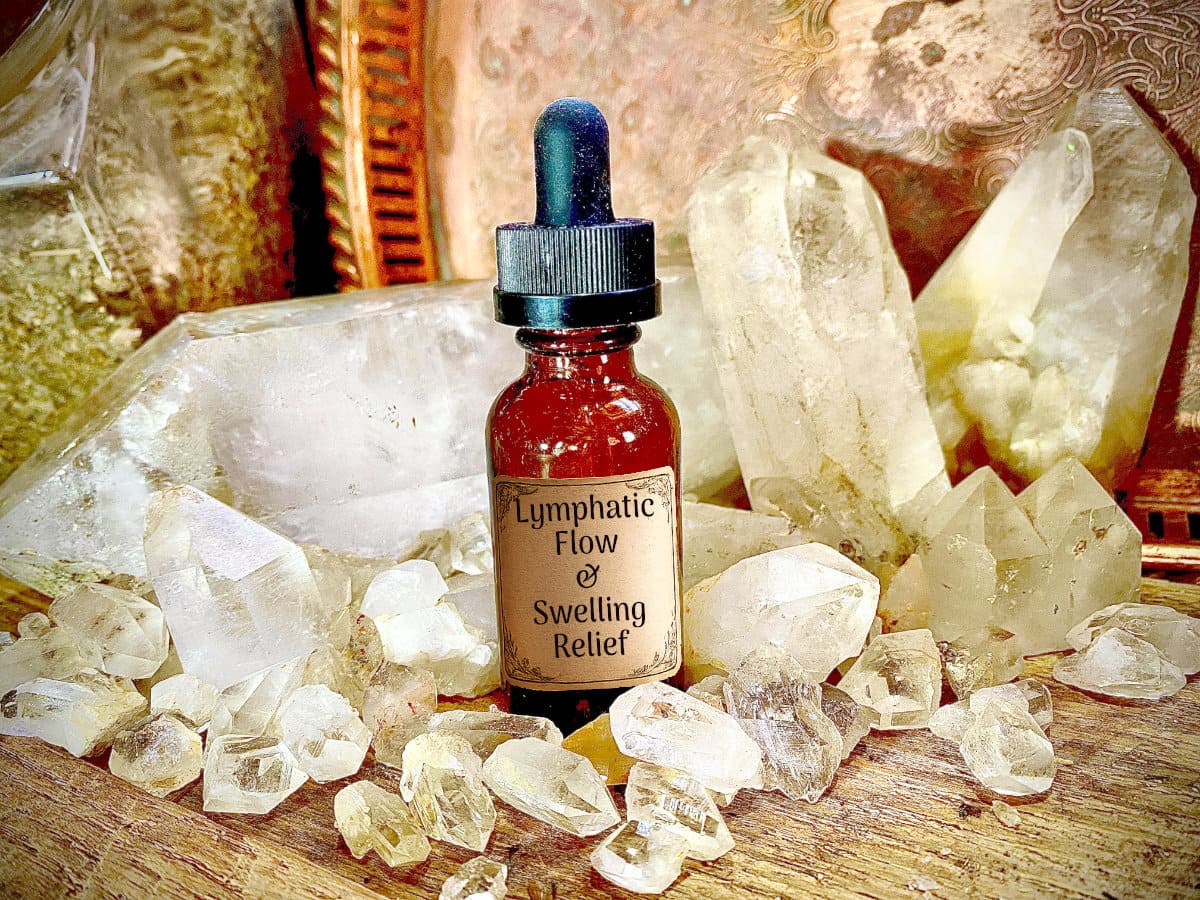
Lymphatic Flow & Swelling Relief was born from the wisdom of the plant kingdom. With allies that have always known how to move what is stuck, to soften what is rigid and to carry what has been held too long toward its rightful release. This potion speaks the language of your body’s rivers. It is an invitation back to flow.
Why Lymph Stagnates: The Modern Body in Crisis
Unlike the cardiovascular system, the lymphatic network has no central pump. It relies entirely on movement: the breath expanding and contracting the diaphragm, the muscles engaging with walking and stretching and reaching, the gentle peristalsis of digestion. When these natural rhythms are interrupted, lymph slows. It pools. It carries its burden of cellular debris, spent immune cells, metabolic waste, and unmetabolized emotion without a current to carry it home.
Lymphedema, chronic swelling, inflammatory conditions, seasonal allergies, sluggish detoxification, these are the body’s faithful attempt to cope with conditions it was never designed for. Such as chairs that compress the inguinal nodes for eight hours at a time, synthetic foods that create more inflammatory byproducts than any system can process gracefully, and chronic stress hormones that redirect the body’s resources away from the quiet work of lymphatic maintenance.
The thyroid, often at the center of metabolic imbalance, sits surrounded by cervical lymph nodes that, when congested, can impair its ability to communicate with the rest of the body. Immune function depends on the free movement of lymphocytes and macrophages through lymphatic channels. When flow is impaired, so is the body’s capacity to distinguish friend from threat, to resolve inflammation, to remember how health feels.
The Green Council: Plant Allies in This Potion
Every plant in this formula was chosen by relationship from thousands of years of human and plant learning each other’s languages. They arrive here as a council of green intelligence, each one offering a specific form of lymphatic wisdom.
Ocotillo
Elephant Foot
Cleavers
Echinacea
Wood Sorrel
Violet
Petunia
Bittercress
Field Matter
Phlox
Day Lily
Women’s Tobacco
Dandelion
Ginseng
Self Heal
Chickweed
River Birch
Agave Alcohol
Quartz Crystal
Cleavers
Cleavers (Galium aparine) is perhaps the most direct plant ally for the lymphatic system as this plant is all about connection with its trailing, branching stems covered in tiny hooked bristles that grab onto everything they touch. Often caught on clothing, animal fur, neighboring plants, and the hands of anyone who brushes through it. It moves by attachment, relationship, and the capacity to reach, hold, carry. This is the nature of the lymphatic system itself: it exists entirely at the interface between things, gathering what flows between, carrying what cannot travel alone, making connection where separation would mean stagnation.
Physiologically, Cleavers is a lymphagogue, which is a substance that specifically promotes lymphatic flow as it acts through several complementary mechanisms. Its iridoid glycosides and tannins have a toning effect on the walls of lymphatic vessels themselves, improving the elasticity and contractility of the lymphangion segments that rhythmically propel lymph forward through one-way valves. A lymphatic system whose vessels have lost tone is like a river whose banks have softened into mud: the current slows, the water spreads and pools, and the cleansing that should happen in concentrated, directed flow disperses into stagnant wetland. Cleavers restores the banks.
Cleavers is also a significant alterative and lymphatic decongestant for the nodes themselves. The lymph nodes that swell and harden under chronic immune activation, the cervical nodes that become pebbles beneath the jaw, the axillary nodes that make it uncomfortable to lower an arm, the inguinal nodes that press against the inner thigh, these respond to Cleavers through its combination of lymphagogue action and gentle anti-inflammatory chemistry. Traditional herbalists in Europe and North America used Cleavers specifically for “glandular swellings,” what we would now identify as chronically activated lymph nodes and for conditions they called “scrofulous,” recognizing the pattern of lymphatic burden that underlies so many chronic skin and immune conditions.
As a diuretic, Cleavers also supports the kidneys as the downstream exit for the fluid that the lymphatics mobilize. This pairing of lymphagogue and diuretic in a single plant is part of what makes it so elegant for swelling and fluid retention: it not only moves the accumulated lymphatic fluid but ensures it has somewhere to go. Without supported kidney elimination, mobilizing lymphatic congestion can simply shift fluid burden from one tissue compartment to another. Cleavers holds both ends of the process, upstream and downstream, in the same green handful.
Ocotillo
Ocotillo (Fouquieria splendens) rises from the Sonoran and Chihuahuan desert floors in long, thorned wands that can reach fifteen feet, remaining dormant and leafless through months of drought and then erupting almost overnight into green when rain falls. This is a plant that has perfected the art of waiting until conditions are right, then moving all at once with spectacular efficiency. This is also a description of lymphatic healing in the lower body, where years of accumulated stagnation can begin to shift with remarkable speed once the right conditions are created. Ocotillo knows how to work with the desert body, the body that has been holding everything tightly against scarcity and then is asked to trust the flood.
Ocotillo’s primary lymphatic affinity is for the pelvis and lower extremities, the regions drained by the inguinal lymph nodes, where the lymphatics of the legs, genitals, lower abdomen, and gluteal tissues all converge. This is one of the most commonly congested lymphatic regions in modern bodies: hours of sitting compress the inguinal nodes directly, while the sedentary lifestyle that compresses them also eliminates the walking and movement that would otherwise propel lymph through the one-way valves of the lower lymphatic channels. The result is a particular heaviness and swelling in the legs and lower body that is familiar to anyone who has spent long hours at a desk.
The plant’s active constituents include isorhamnetin and kaempferol, flavonoids with anti-inflammatory and circulatory-supportive properties and a resinous fraction that supports mucosal tissue throughout the digestive and reproductive tracts. This mucosal affinity is significant because the lymphatic tissue lining the gut, called gut-associated lymphoid tissue, or GALT, is the largest concentration of immune tissue in the entire body, responsible for surveilling everything that passes through the intestinal mucosa and determining what is absorbed versus what needs to be defended against. When the mucosal lining is inflamed or compromised, the GALT is perpetually activated, contributing to systemic immune dysregulation and lymphatic burden throughout the body. Ocotillo’s support for mucosal integrity in the lower digestive and pelvic organs directly reduces this burden at its source.
At the emotional and somatic level, Ocotillo speaks to the hips and pelvis as the body’s basin of power, creative force, and sexual energy, as the place where unprocessed emotion is disproportionately stored. The dense connective tissue of the hips and thighs holds the body’s oldest tensions: the bracing that comes from chronic threat, the contraction that accompanies trauma, the frozen action patterns that were never completed. When the lymphatics of this region are congested, the tissue itself is both physically and emotionally dense. Ocotillo brings desert heat to this dense terrain, the kind of heat that loosens and opens, helping the pelvis recall its original capacity for movement, power, and ease.
Violet
Violet (Viola odorata and related wild species) grows low and close to the ground, preferring the edges of things, the places where cultivated land softens into wild. It simply appears, year after year, in the forgotten corners, offering its heart-shaped leaves and its small purple flowers with a constancy. This quality of patient, quiet presence in the margins is exactly the medicine it brings: it works in the body’s forgotten corners, the lymphatic territories so subtle and so intimate that Western medicine barely mapped them before declaring them merely functional.
Violet leaves and flowers are extraordinarily rich in mucilaginous polysaccharides, long-chain sugar molecules that absorb water and form a gel-like substance that coats, soothes, and protects inflamed mucous membranes. This mucilaginous action is the foundation of Violet’s physical medicine: it reduces the irritation and inflammatory signaling in tissues that border lymphatic vessels, creating the conditions for lymph to move more freely through less inflamed terrain. Inflammation around lymphatic vessels is a perpectuating cause of lymphatic stagnation. Inflamed tissue releases cytokines that increase vascular permeability, flooding the interstitial space with more fluid than the lymphatics can manage, which increases congestion, which increases inflammation, in a cycle that Violet interrupts with its cooling, softening chemistry.
Violet also contains rutin, the same capillary-strengthening bioflavonoid found in Wood Sorrel, along with salicylic acid derivatives that provide mild, sustained anti-inflammatory action without the gastric irritation of synthetic analgesics.
Violet’s emotional medicine becomes inseparable from its physical action. The research of Dr. Candace Pert and others in the field of psychoneuroimmunology established that emotions are not merely psychological experiences but molecular events where neuropeptides and their receptors distributed throughout every tissue of the body, including lymphatic tissue. Grief that has not moved through the body to its resolution remains as a molecular pattern in the tissues, particularly in the chest and throat. The act of swallowing words, of holding back tears, of compressing the chest against loss, all of these create chronic muscular tension around the very lymphatic vessels and nodes whose flow depends on movement and release. Violet softens both the physical tension and the emotional holding simultaneously, not by forcing either, but by creating the conditions of safety and ease in which both can let go.
Echinacea
Echinacea (primarily Echinacea purpurea and Echinacea angustifolia) is marketed and consumed primarily as a cold and flu remedy, something to take at the first sign of infection and stop as soon as the illness passes. This framing misses nearly everything important about what Echinacea actually does in the body, and specifically in the lymphatic system through which so much of its medicine works.
The alkylamides and polysaccharides in Echinacea interact directly with cannabinoid receptors (CB2) distributed throughout immune tissue, the same receptor system that helps regulate inflammation, immune cell activity, and pain signaling throughout the body. This CB2 interaction is part of why Echinacea produces its characteristic tingling sensation on the tongue and why it has such a rapid and noticeable effect on the lymphoid tissue of the throat and neck: it is activating a receptor system that the immune cells in lymphatic tissue are listening for. CB2 receptor activation modulates macrophage activity, NK cell function, and the production of inflammatory cytokines by refining its calibration, helping the immune system respond with the right intensity to the actual level of threat rather than overreacting to minor provocations or underreacting to genuine ones.
Echinacea’s polysaccharides also have a direct lymphagogue effect, they increase the flow of lymph through the vessels, and support the activity of hyaluronidase inhibitors, helping to maintain the integrity of the connective tissue matrix that surrounds and supports lymphatic vessels. Pathogens use hyaluronidase to break down this matrix and spread through tissue; Echinacea helps preserve the structural integrity that keeps lymphatic vessels properly anchored and functional even during active infection.
Echinacea is also a specific remedy for the kind of chronic low-grade lymphatic congestion that follows incompletely resolved infections, the lingering swollen nodes and immune fatigue that can persist for months or years after viral illness, Lyme disease, or recurrent bacterial infections. In these states, the lymph nodes are holding an immune memory that was never fully processed to resolution: the battle did not properly end, and the lymphatic tissue remains partially mobilized indefinitely, draining resources without completing its work. Echinacea supports the completion of these incomplete immune responses, helping the lymph nodes move from their state of chronic vigilance into the resting discernment that is the mark of a truly healthy immune system which is present, responsive, and unafraid.
Dandelion
Dandelion (Taraxacum officinale) grows everywhere, costs nothing, is available to everyone, and carries medicine of such depth and breadth that entire books have been written about this single plant. It is also the most eloquent example of a plant whose medicine operates at the intersection of multiple body systems simultaneously, making it impossible to discuss its role in lymphatic health without also discussing the liver, kidneys, digestive system, and the endocrine system because Dandelion does not recognize the divisions we have drawn between these organs. It sees and works with the whole body as a single drainage ecology.
The liver and the lymphatic system share one of the most intimate relationships in the body. Approximately half of all lymph in the body originates in the liver, a fact that most discussions of lymphatic health entirely overlook. The liver produces enormous quantities of protein-rich fluid that drains through hepatic lymphatics and contributes substantially to the flow in the thoracic duct. When the liver is burdened by dietary excess, alcohol, environmental toxins, pharmaceutical processing, viral hepatitis, or the accumulated demands of processing the inflammatory chemistry of chronic stress. Its lymphatic drainage becomes congested, and this congestion propagates backward through the thoracic duct into the systemic lymphatic circulation. You cannot effectively address lymphatic stagnation in a body with a burdened liver.
Dandelion root acts on the liver through several pathways: it stimulates bile production and bile flow, supporting the emulsification and elimination of fat-soluble toxins; it increases the production of superoxide dismutase and other endogenous antioxidants that protect liver cells from oxidative damage; and it supports the activity of cytochrome P450 enzymes involved in Phase I detoxification. Dandelion leaf, meanwhile, is one of the most effective botanical diuretics known, providing potassium-sparing diuresis that supports kidney elimination without depleting electrolytes. This dual action of liver support via the root, kidney support via the leaf means that Dandelion simultaneously opens the two primary processing organs that lymph must ultimately drain through.
Dandelion also contains taraxacin and taraxacerin which are bitter sesquiterpene lactones that activate the entire bitter receptor cascade throughout the digestive system, along with inulin, a prebiotic fiber that feeds the beneficial bacteria of the gut microbiome. The gut microbiome has been found to have direct bidirectional communication with the GALT and with lymphatic tissue throughout the body. A healthy microbiome supports immune regulation and reduces the inflammatory signaling that burdens lymphatic vessels, while a gut that lacks a healthy microbiome generates chronic immune activation that perpetuates lymphatic congestion. Dandelion works at this root level, restoring the digestive foundation upon which all systemic health, including lymphatic health.
Self Heal
Self Heal (Prunella vulgaris) grows in lawns, meadows, and roadsides on every inhabited continent, finding its way into the most ordinary places. Herbalists across traditions, Chinese, European, North American indigenous, have used Self Heal for thousands of years for conditions involving immune dysregulation, lymphatic swelling, fevers that will not resolve, and wounds that will not heal.
The rosmarinic acid in Self Heal is one of its most studied constituents, with documented anti-inflammatory, antioxidant, antiviral, and immunomodulatory properties. Rosmarinic acid inhibits the complement system which is a cascade of immune proteins that, when chronically activated, contributes significantly to the inflammatory burden that lymphatic vessels must constantly navigate. Complement activation is part of normal acute immune response, but in chronic inflammatory states it becomes a driver of the very conditions it was meant to resolve. Self Heal’s regulation of this cascade is part of how it creates the conditions in which healing becomes possible not by suppressing immunity, but by returning it to proportionate response.
Self Heal also contains ursolic acid, a triterpenoid with significant anti-tumor and lymphoprotective properties, and hyperoside, a flavonoid with particular affinity for the thyroid gland making it specifically relevant to the thyroid-lymphatic relationship that underlies so many cases of chronic lymphatic congestion. The thyroid gland sits surrounded by cervical lymph nodes and depends on functional lymphatic drainage for its own healthy metabolism; when these nodes are chronically congested, thyroid function is directly impaired. Self Heal’s affinity for both lymphatic tissue and thyroid tissue makes it one of the formula’s most important bridges between these two systems.
In the Chinese medical tradition, Prunella vulgaris (Xia Ku Cao, meaning “summer dry grass”) is classified as a plant that clears liver fire and dissipates nodules, a description that maps precisely onto its Western herbal uses for swollen lymph nodes, thyroid nodules, and the conditions of chronic low-grade inflammation that leave the body simultaneously hot and depleted. The liver fire that Chinese medicine describes is the same phenomenon that Western physiology identifies as chronic oxidative stress and inflammatory signaling in the liver-lymphatic axis. Self Heal speaks to it in the same language from both sides of the world.
Ginseng
Ginseng (Panax ginseng, or in North American formulations, Panax quinquefolius) has been at the center of East Asian medicine for over two thousand years, and its inclusion in this lymphatic formula speaks to a dimension of lymphatic burden that most lymphatic support protocols fail to address: the depletion of the vital force that drives the whole system. The lymphatic system is not passive. It requires energy, the energy of breathing, of moving, of the rhythmic contractions of the lymphangion smooth muscle, of the cellular activity of millions of immune cells constantly patrolling, processing, and communicating. When the body has been carrying lymphatic burden for a long time, this energy is exhausted along with the structural congestion, and no amount of drainage support will restore flow if the fundamental vitality needed to sustain it has been depleted.
Ginseng’s primary active constituents are the ginsenosides which are a family of triterpenoid saponins that interact with steroid hormone receptors, the HPA axis, mitochondrial function, and immune signaling in ways that are collectively described as adaptogenic: they help the body’s regulatory systems maintain or restore homeostasis under conditions of stress that would otherwise push them into dysregulation. For the lymphatic system specifically, ginsenosides Rg1 and Rb1 have been shown to directly support lymphocyte proliferation and NK cell activity, to reduce the chronic inflammatory cytokine production that burdens lymphatic vessels, and to protect lymphatic endothelial cells from the oxidative damage that impairs their function in chronic illness states.
Ginseng also has a profound relationship with the adrenal glands and the stress response system, a relationship directly relevant to lymphatic health. Chronic activation of the HPA axis, the hypothalamic-pituitary-adrenal stress response, produces sustained cortisol elevation that suppresses lymphocyte activity, impairs lymph node function, and reduces the lymphatic system’s capacity to mount effective immune responses. The same chronic stress that stagnates lymphatic flow through behavioral means (sedentary posture, shallow breathing, disrupted sleep) also stagnates it through hormonal means. Ginseng works on both sides of this equation: it supports the adrenal response to stress while simultaneously protecting the immune-lymphatic system from cortisol’s suppressive effects, threading the needle between exhaustion and hyperactivation.
In Chinese medicine, Ginseng tonifies the Yuan Qi, the original essence, the constitutional vitality that was given to us at birth and that we spend across the arc of our lives. It is a plant given when someone has used themselves up, when the reserves that should sustain a lifetime have been drawn down by extraordinary demand: by years of chronic illness, by caregiving that never stopped, by carrying the weight of more than any one body should carry. For those whose lymphatic stagnation is rooted in this kind of deep depletion, Ginseng does not simply stimulate; it restores.
Wood Sorrel
Wood Sorrel (Oxalis stricta and related species) is a small plant of extraordinary complexity, found in disturbed soils and garden edges, easy to overlook and impossible to underestimate. Its bright lemony flavor comes from oxalic acid, and it is this chemistry that points toward one of its primary gifts: it is a powerful alkalizing and acid-clearing medicine. The lymphatic system is intimately bound up with pH balance in the body. When tissues become too acidic, as they often do under chronic stress, poor elimination, inflammatory diet, or cellular debris accumulation. The lymph thickens, flow slows, and the interstitial fluid surrounding every cell becomes a less hospitable medium for nutrient exchange and waste removal.
Wood Sorrel also contains rutin, a bioflavonoid that strengthens capillary walls and reduces their permeability, which directly addresses one of the root mechanisms of lymphedema and chronic swelling. When capillaries are weakened or overly permeable, excess fluid leaks into the interstitial space faster than the lymphatic capillaries can gather and return it. Rutin essentially repairs the vessels at their walls, reducing the flood that the lymphatics must manage. It also carries antioxidant and mild anti-inflammatory action, making it particularly useful in conditions where oxidative burden is contributing to lymphatic congestion.
Traditional use of Wood Sorrel spans many cultures and continents, consistently pointing toward its role in cooling excess heat, clearing toxins from the blood and liver, and supporting kidney function as a filtration and elimination pathway. The kidneys and lymphatics are deeply interdependent, such as when the kidneys filter efficiently, the pressure on lymphatic drainage decreases. When the kidneys are burdened, the lymphatics compensate, and both systems ultimately suffer. Wood Sorrel supports the whole filtration ecology of the body, not just a single organ.
Chickweed
Chickweed (Stellaria media) is one of the most abundant and most underestimated of all herbal allies. It grows wherever humans disturb soil, returning again and again with a patience that borders on devotion, offering its cooling, moistening medicine to any body willing to receive it. It is a deeply nutritive plant, rich in vitamins C and B vitamins, iron, calcium, and saponins. It carries a quality of action that herbalists describe as resolving as it softens, disperses, and clears accumulations that have hardened through time and heat.
For the lymphatic system, Chickweed is particularly indicated when there is inflammation in the lymph nodes themselves. When hot, tender swellings that accompany immune activation, infection, or chronic inflammatory states. Its saponins support the emulsification of fats within the lymph, which is significant because the lymphatic system is the primary route through which dietary fats are transported from the gut into the bloodstream. When lymphatic flow in the abdomen, in the lacteals and the cisterna chyli, are sluggish, fats accumulate in ways that further burden the system. Chickweed’s saponin content helps break down and move these fat-soluble burdens, easing the work of the deeper abdominal lymphatics.
Chickweed also has a specific affinity for skin and the superficial lymphatic vessels that run just beneath it. Skin conditions that reflect lymphatic burden include chronic eczema, psoriasis, boils, cysts. Psoraisis and Eczema Relief or Psoriasis and Eczema Topical Relief. Each of these respond to Chickweed both topically and internally, because the plant addresses the underlying lymphatic stagnation that allows these conditions to persist. Energetically, traditional herbalists associate Chickweed with the capacity to move and release what the body has been holding too tightly, emotional as well as physical accumulation.
Bittercress
Bittercress (Cardamine hirsuta and related species) is a cruciferous plant of early spring and late winter, appearing in gardens and pathways with its tiny white flowers before most other plants have stirred. Its name tells the whole story: it is bitter, and bitterness is medicine that the modern palate has almost entirely eliminated from its experience, to our profound physiological detriment. Bitter taste receptors, activated in the mouth and throughout the digestive tract, stimulate a cascade of digestive secretions: bile from the gallbladder, digestive enzymes from the pancreas, hydrochloric acid from the stomach. This cascade is the beginning of lymphatic health, because efficient digestion means less unprocessed material reaching the lymphatic vessels of the gut.
The lacteals, specialized lymphatic vessels within the intestinal villi, absorb dietary fats and fat-soluble nutrients from the digestive tract and carry them via the mesenteric lymphatics through the cisterna chyli and up the thoracic duct into systemic circulation. When digestion is poor and food is only partially broken down, the lacteals must process a more complex and burdened fluid. Over time this contributes to mesenteric lymphatic congestion, which in turn affects the liver, the spleen, and the immune tissue densely concentrated around the gut. Bittercress, by stimulating thorough digestion at its source, reduces the burden placed on this entire downstream system.
Bittercress also contains glucosinolates, the sulfur-containing compounds found throughout the cruciferous family that have been extensively studied for their role in supporting liver detoxification pathways, particularly Phase II liver detox, where fat-soluble toxins are conjugated and made water-soluble for excretion. This is critical for lymphatic health because many of the toxins carried by lymph are fat-soluble, including environmental pollutants, excess hormones, and metabolic byproducts. Without efficient liver processing, these compounds recirculate. Bittercress helps the liver complete its work, so that the lymph is not perpetually re-carrying what should have been excreted.
River Birch
River Birch (Betula nigra) grows at the margins of moving water. Birch bark and leaves contain betulin and betulinic acid, triterpenoid compounds with significant anti-inflammatory, antiviral, and lymphagogue properties. Betulin has been shown to inhibit NF-kB, one of the primary transcription factors driving chronic inflammatory signaling. When chronic inflammation is the context for lymphatic stagnation, as in autoimmune conditions, long COVID, chronic Lyme, and environmental illness, addressing the inflammatory signaling itself is essential rather than simply trying to push fluid through a system that remains chemically inflamed, which River Birch does beautifully.
Birch is also a significant diuretic and kidney tonic supporting the urinary tract as a fluid elimination pathway that works in partnership with lymphatic drainage. When excess fluid is being moved through the lymphatics, it must ultimately exit the body through the kidneys, bowel, skin, or lungs. A well-supported kidney system means that as lymphatic drainage improves, there is an efficient exit route for the fluid being mobilized. Without this, moving lymph without supporting elimination can simply redistribute congestion. Birch addresses this intelligently, opening the downstream pathways simultaneously with upstream lymphatic support.
River Birch also brings structural intelligence as it supports connective tissue integrity, which has direct implications for the lymphatic vessels themselves. Lymphatic capillaries are anchored to surrounding connective tissue by filaments that literally pull the vessel walls open in response to tissue swelling, creating the suction that draws interstitial fluid in. When connective tissue is degraded, as it can be in conditions involving chronic inflammation, collagen disorders, or post-viral syndromes, these anchoring filaments lose their capacity to open the lymphatic capillaries appropriately. Birch’s support for connective tissue health is support for the mechanical architecture of lymphatic function itself.
Elephant Foot
Elephant Foot (Elephantopus species) is a plant used across traditional medicine systems in Africa, South and Central America, and Southeast Asia with remarkable consistency for conditions involving lymphatic congestion, spleen enlargement, and compromised immune function. Its widespread traditional use across entirely separate healing traditions, traditions that developed independently and without cross-pollination, is itself a form of evidence, pointing toward an efficacy real enough that healers in many different contexts arrived at the same relationship with this plant.
The spleen is the largest lymphatic organ in the body, and its role is often underappreciated in discussions of lymphatic health. It is simultaneously a blood filter, an immune organ, an emergency blood reservoir, and a recycling center for old red blood cells. The spleen is densely populated with lymphocytes and macrophages, and it is one of the primary sites where the immune system mounts its surveillance of blood-borne pathogens and damaged cells. When the spleen is congested or enlarged, as it can be in chronic infection, autoimmunity, mononucleosis, or immune exhaustion, the entire lymphatic-immune axis is affected. Elephant Foot has been used specifically to address splenomegaly and to restore normal spleen function in traditional medicine, making it a uniquely valuable ally for conditions where lymphatic and immune dysfunction are rooted in splenic overload.
Contemporary research on Elephant Foot species has identified sesquiterpene lactones and triterpenoids with anti-inflammatory, antitumor, and immunomodulating properties: compounds that may help explain the plant’s observed capacity to reduce abnormal immune activation while supporting appropriate immune function.
Petunia
Wild Petunia (Ruellia species, distinct from ornamental garden petunias) represents a thread of traditional plant medicine that remains less documented in formal herbal literature but is deeply embedded in folk healing practice across the Americas. Wild Ruellia species have been used in Brazilian traditional medicine for anti-inflammatory and lymphatic supportive effects, and in North American folk herbalism for their action on congested lymphatic tissue, particularly in the head, neck, and respiratory tract where lymphatic drainage intersects with immune surveillance of inhaled environmental material.
The lymphatics of the head and neck, the cervical, submandibular, and parotid nodes, are often the first to become palpably swollen during immune activation, because they drain the tissues most directly exposed to environmental challenge: the sinuses, ears, throat, and scalp. Chronic upper respiratory congestion, seasonal allergies, and recurrent sinus infections often reflect chronic lymphatic congestion in this region, where immune tissue is perpetually managing an overwhelming load of environmental antigens. Petunia’s traditional use in supporting drainage in these tissues makes it particularly relevant for the allergy and congestion dimensions of lymphatic burden that so many people carry year-round.
There is also a dimension of Petunia’s medicine that traditional healers associate with the opening of perception, the capacity of the body to receive information from its environment more clearly when the channels of drainage are open. This speaks to a truth that physiology is only beginning to quantify: the glymphatic system of the brain, which drains waste from neural tissue primarily during sleep, is part of the same broader lymphatic intelligence of the body. When lymphatic burden is high throughout the system, this neural drainage is also impaired, contributing to brain fog, difficulty concentrating, disturbed sleep, and the feeling of being clouded that so many with chronic lymphatic congestion describe. Petunia, by supporting drainage in the head and neck tissues, contributes to this clearing of the channels of perception, the reopening of clarity that feels, to those who experience it, like finally being able to think again.
Field Madder
Field Madder, Field Cleavers, or Blue Fieldmadder (Sherardia arvensis) is a small, sprawling annual of the Rubiaceae family, the same botanical family that includes Cleavers (Galium aparine), Coffee (Coffea arabica), and Bedstraw (Galium verum). This family kinship is not incidental: the Rubiaceae are a family whose members share a notable pattern of action on the lymphatic and circulatory systems, on the kidneys as elimination pathways, and on the body’s capacity to process and clear what has accumulated. Sherardia is the humble, field-dwelling expression of this family intelligence, found growing low across grain fields, disturbed meadows, and roadsides throughout Europe, North Africa, and western Asia, and naturalized across much of North America where European settlers carried its seeds inadvertently in grain stocks and animal fodder.
Like its cousin Cleavers, Sherardia arvensis possesses tiny hooked hairs along its stems and leaf whorls that catch and cling, a structural characteristic shared by plants in this family that are indicated for lymphatic work. Its small, four-petaled flowers range from pale lilac to soft pink, appearing from late spring through autumn. Traditional European herbalists, particularly in British and Irish folk medicine, used Sherardia as a substitute for or complement to Cleavers when the latter was not available, applying it to similar conditions: swollen glands, skin eruptions reflecting internal lymphatic burden, urinary gravel, and the sluggish states of constitution that traditional medicine called cachexia or “bad blood.”
The phytochemistry of Sherardia arvensis reveals iridoid glycosides, notably asperuloside and related compounds, which are characteristic of the Rubiaceae family and carry the biochemical signature of that family’s lymphatic and diuretic action. Asperuloside has demonstrated anti-inflammatory activity through inhibition of prostaglandin synthesis, reduction of COX-2 expression, and modulation of NF-kB signaling, the same inflammatory transcription factor that River Birch’s betulin addresses through a different molecular pathway. Where Birch works on the architecture of connective tissue in which lymphatic vessels are embedded, Sherardia works on the chemical signaling environment that governs whether those vessels operate in a state of inflammatory activation or calm, efficient drainage.
Sherardia also contains tannins, flavonoids, and a red dye compound in its roots, the latter giving it the “madder” name shared with its relative Rubia tinctorum, the true madder used historically as a textile dye and recognized in folk medicine for its action on the blood and lymph. This dye chemistry is associated in the Rubiaceae family with compounds that support circulatory tone and lymphatic vessel wall integrity, the same structural intelligence that makes the whole family relevant to lymphatic health. In Sherardia, these compounds are present in gentler concentration than in Rubia, making it suited to long-term tonic use rather than acute treatment, a plant for the patient, sustained restoration of a system that has been congested not for days but for months or years.
In the context of this formula, Sherardia arvensis carries the alterative principle, the class of medicine that works not by dramatic intervention but by the slow improvement of the internal conditions that health requires. Alteratives were the backbone of traditional medicine for the chronic conditions we now recognize as long-term lymphatic burden: persistent skin eruptions, chronically swollen glands, joint inflammation that shifts and wanders, low immune resilience, the constitutions that in older medical language were called “scrofulous” or “lymphatic.” They were understood to work on the quality of the blood and lymph itself, improving the medium through which all cellular nutrition and cellular waste removal happens, so that the tissues could gradually return to a more vital baseline.
Phlox
Phlox (Phlox divaricata) flowers across meadows and open woods in shades from white to deep magenta. Wild Phlox species carry anti-inflammatory flavonoids and phenolic compounds that support microcirculation, the movement of blood and fluid through the finest capillaries, which directly affects the efficiency of lymphatic uptake at the tissue level.
The relationship between capillary health and lymphatic function is intimate and bidirectional. Blood capillaries deliver nutrients, oxygen to cells and collect waste, but they also continuously leak fluid into the interstitial space, this is normal and by design. The lymphatic capillaries are responsible for collecting this leaked fluid along with the proteins and cellular debris it carries, and returning it to the bloodstream. When microcirculation is sluggish or when capillary walls are fragile and over-permeable, the volume of leaked fluid increases and lymphatic capacity is overwhelmed. Plants that support healthy capillary tone and microvascular perfusion reduce the volume of work the lymphatics must manage, allowing them to function more efficiently within their natural capacity.
There is also a quality of Phlox medicine that speaks to the solar plexus, to the place in the body where clarity of will and the capacity for forward movement live. Lymphatic stagnation is often accompanied by a loss of vitality and direction, a dimming of the internal light that knows where it is going and why. Phlox, with its radiant flowering, brings something of that quality back as the lived experience of a body whose tissues are better able to circulate, whose cells are receiving what they need and releasing what they do not, whose immune intelligence is operating in a cleaner, more luminous internal environment.
Day Lily
Day Lily (Hemerocallis fulva) has a long history of use in Chinese medicine, where both the flowers and roots are considered medicinal, with particular affinity for the liver and the clearing of heat and dampness from the body, conditions that would be recognized as inflammatory lymphatic congestion. In Traditional Chinese Medicine, the concept of dampness describes a condition in which fluids have lost their normal movement and have begun to accumulate in tissues, creating heaviness, sluggishness, swelling, and clouded thinking. The lymphatic system is, in many ways, the organ of dampness resolution in the body, and Day Lily’s classical indication for this pattern makes it a natural ally in a lymphatic formula.
The roots of Day Lily contain steroidal saponins and polysaccharides with documented anti-inflammatory and immunomodulatory properties. The polysaccharides in particular support macrophage activity, the first-responder immune cells that patrol lymphatic and connective tissue, consuming debris and initiating appropriate immune responses. Healthy macrophage function is essential for lymphatic cleansing: these cells are literal participants in the work of clearing the lymph nodes, and their activity is what transforms a lymph node from a site of immune activation back into a resting, draining tissue when the immune challenge has passed. When macrophage activity is sluggish, as it becomes under chronic inflammation, nutritional depletion, or immune exhaustion, lymph nodes remain chronically activated and swollen even when no acute infection is present.
Day Lily also carries a quality of deep nourishment, it is not primarily a mover or a drainer, but a rebuilder. For bodies that have been carrying lymphatic burden for a long time, where depletion has set in alongside stagnation, Day Lily offers the nutritive intelligence that supports the system’s capacity to restore itself rather than simply being pushed through another drainage cycle. In herbal medicine traditions across both East and West, there is a foundational understanding that drainage must be matched with nourishment, that the rivers cannot simply be emptied without also being fed. Day Lily is part of the feeding: the medicine that ensures the lymphatic system is rebuilding its capacity even as it releases its accumulated burden.
Women’s Tobacco
Plantain-leaved Pussytoes (Antennaria plantaginifolia), known across Appalachian and Ozark tradition as Women’s Tobacco, is a small, mat-forming perennial of the Asteraceae family that grows in dry, open woods and rocky meadows, spreading quietly across the ground in silvery-green rosettes that hug the earth and hold their territory with a gentle, persistent rootedness. Its common name Women’s Tobacco comes from its traditional ceremonial and medicinal use among indigenous peoples of eastern North America, where the dried leaves were sometimes smoked or burned for their calming, boundary-clarifying medicine, distinct entirely from commercial tobacco in both chemistry and intention.
The plant’s phytochemistry includes flavonoids, particularly luteolin and quercetin, along with tannins, resinous compounds, and triterpenes characteristic of the Asteraceae. Luteolin is one of the most extensively studied anti-inflammatory flavonoids in botanical medicine, with documented inhibition of pro-inflammatory cytokines including IL-6, IL-1β, and TNF-α. The same cytokine cascade that perpetuates chronic lymphatic congestion by keeping vessel walls in a state of low-grade inflammatory activation. Quercetin brings its own anti-inflammatory and antihistamine action, making Antennaria particularly relevant to the allergy dimension of lymphatic burden: the chronic immune activation of the upper respiratory lymphatics in people who move through the world with histamine responses perpetually triggered. Together these flavonoids help lower the baseline inflammatory tone in lymphatic tissue without suppressing immune function, calming the noise so the signal can be heard.
The tannins in Antennaria plantaginifolia have an astringent action on mucous membranes and lymphatic tissue, supporting the toning of vessel walls and the resolution of the boggy, waterlogged tissue quality that characterizes lymphedema and chronic inflammatory swelling. Where Violet softens and moistens inflamed lymphatic tissue, Pussytoes tones and firms tissue that has lost its structural integrity through prolonged edema, making these the two plants working complementary sides of the same restoration. Traditional use of Antennaria in women’s medicine specifically addressed conditions of heaviness, fluid retention, and the kind of diffuse, hard-to-locate discomfort that often accompanies hormonal lymphatic burden in the premenstrual phase or during perimenopause, when fluctuating estrogen directly affects lymphatic vessel permeability and fluid balance throughout the body.
Agave Alcohol & Quartz Crystal
The potion is prepared in agave alcohol, a plant-derived carrier that preserves the full spectrum of each plant’s medicine while allowing it to be absorbed rapidly through the tissues under the tongue. Quartz crystal is included in the preparation process as an amplifier, a mineral that, in many healing traditions, is understood to clarify and intensify intention and energy.
How to Receive This Medicine
Suggested Use Take 5–10 drops directly under the tongue. Hold for at least 30 seconds before swallowing. Use 2–3 times daily. Follow a cycle of 5 days on, 2 days off. Repeat as needed. The pause helps the body continue to only need a micro dose, rather than creating dependency on the medicine.
The sublingual pathway, under the tongue, or can be inserted into he belly button, allows the plant medicine to move directly into the bloodstream without the first pass through digestive organs. For lymphatic support, this means the plants arrive quickly into systemic circulation, able to support lymphatic drainage throughout the body rather than just in the gut.
The 5-days-on, 2-days-off rhythm honors the bodies need for space to integrate, respond, and allow changes initiated by the medicine to complete their arc without constant stimulation. The off days are are part of the healing. Allowing the body to maintain a micro dose rather than having to use more and more of the medicine to receive the same benefits.
The Sacred Embodied Human Animal
Somewhere along the arc of becoming civilized, we forgot something essential: we are animals. Gloriously, improbably, beautifully embodied animals. Creatures of skin, breath, fluid and bone, held together by intelligence so vast it operates entirely without our conscious participation.
The lymphatic system is one of the most eloquent expressions of this animal intelligence. It simply flows, when we let it. It simply clears, when we stop obstructing it. It simply heals, when we create the conditions that healing requires.
To work with a potion like Lymphatic Flow & Swelling Relief is not to outsource your healing to a bottle. It is to enter into relationship with the plant kingdom. With a simply statement of: I remember that I need you, that we are kin, that the same water that moves through your roots and stems also moves through my vessels. Teach me again how to flow.
The Sacred Embodied Human Animal framework holds that health is not a destination but a practice of returning, over and over, day after day, to the truth of what we are beneath the layers of productivity, performance and chronic disconnection from our own sensing, feeling, knowing bodies. It holds that the body is not a problem to be solved but a mystery to be inhabited. That symptoms are not failures but messages. That healing happens not through the elimination of difficulty but through the cultivation of relationship with our bodies, with the plant world, and with the water that moves through all living things.
Every time you place this medicine under your tongue, you are participating in an act of remembering. Remembering that your lymph is sacred water. That your swelling is not a malfunction but a signal. That your immune system is not at war with the world but learning to navigate it with ever-greater wisdom. That somewhere in the web of green intelligence that covers this earth, allies have always existed who know how to help you find your way back to flow.
Practices That Amplify This Medicine
No potion works in isolation. The plant allies in this formula are most effective when supported by the movement and breath that your lymphatic system was designed to require. These practices are are invitations.
Breathe Into the Belly
The diaphragm, when it moves with full, deep breath, massages the thoracic duct, the central channel through which the majority of the body’s lymph drains back into the bloodstream. Even five minutes of intentional belly breathing morning and evening creates a significant increase in lymphatic flow. Breathe in through the nose, let the belly expand fully. Breathe out slowly through the mouth. Feel the river begin to move.
Move Like You Were Meant To
Walk, bounce gently on a trampoline or the balls of your feet, swim, dance, stretch in spiraling patterns rather than straight lines. The lymphatic system has one-way valves that require the rhythmic compression of surrounding muscles to function. Any movement is lymphatic medicine and the more it resembles the movements humans evolved to make, the better.
Dry Brush With Presence
Using a natural bristle brush, brush toward the heart in long, gentle strokes before bathing. Start from the feet and move upward; start from the hands and move toward the shoulders. This awakens the superficial lymphatic vessels just beneath the skin. Do it slowly enough to feel what you are touching. The presence you bring to the practice is part of the medicine.
Hydrate As a Sacred Act
Lymph is largely water. A dehydrated body is a sluggish lymphatic body. Drink clean water as an act of reciprocity with the fluid nature that you are. The rivers within you need the rivers from outside to keep flowing.
Grieve What Needs Grieving
The lymphatic system carries emotional residue as surely as it carries cellular debris. Unexpressed grief, suppressed rage, the accumulated weight of witnessing what has been lost, all of this finds its way into the lymphatic burden. This potion can help create movement in the emotional body as well as the physical one. Be gentle with yourself if feelings arise as the rivers begin to flow again. This too is part of the cleansing.
A Word From the Green World
The plants that gave themselves to this formula did not come from laboratories or from supply chains designed to scale medicine into commodity. They come from relationship between myself as a Sacred Embodied Human Animal and the specific intelligence of each Sacred Embodied Plant, between the ecology that produced these plants and the bodies that need them.
When you use this medicine, you are participating in a lineage of relationship between humans and the plant world that stretches back further than history. You are remembering that healing is something you participate in, with your body, with the Earth, and with the intelligence that flows through all living systems toward wholeness.
May your rivers run clear. May your immune wisdom deepen. May the sacred waters within you carry whatever no longer serves toward its release, and bring forward what has always been trying to emerge.
You are the river. You are the flow. You are the return.
Lymphatic Flow & Swelling Relief is a handcrafted plant extract intended to support the body’s natural processes. It is not a substitute for medical care. If you are pregnant, nursing, taking medications, or managing a medical condition, please consult with a qualified practitioner before use. Statements about this product have not been evaluated by the FDA. This product is not intended to diagnose, treat, cure, or prevent any disease.
 Unlock with Patreon